Astrology is an interpretive art based in astronomical mathematics. Ray Grasse brings his genius and warmth to each substack reader delivering perceptive insights as an expert Astrology. If you can read it's easy to understand Ray. Jamie Forbes, Publisher Fineartmagazine blog blogspot.
https://substack.com/@raygrasse



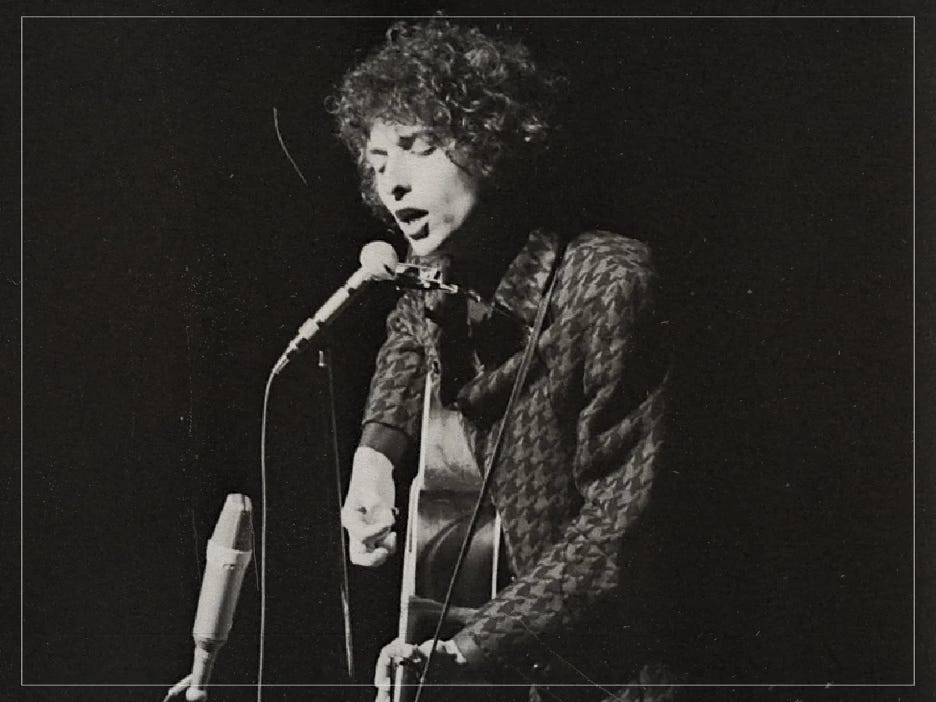 |
Credit: Far Out / Bibliothèque nationale de France
In one of my first astrology classes many years ago, a fellow classmate asked my early astrology teacher, Goswami Kriyananda, the following question: “What shows poetic talent in a horoscope?”
He replied, “You’d have to look at the person’s Mercury, of course.” But he paused a bit then added this: “When it comes to pretty poetry, pleasant poetry, that would be Mercury-Venus. But great poetry? That would be Neptune-Mercury.”
I was intrigued by that, especially since I had just been studying the horoscope of singer Bob Dylan, who happened to be born under a Neptune-Mercury square. The more I thought about that planetary aspect and all the ways it played out in Dylan’s life, the more it elicited a flood of related thoughts and impressions for me.
But first of all, why would Mercury combined with Neptune potentially lend itself to poetic greatness?
By way of contrast, think for a moment of a very different planetary combination like Mercury-Saturn, which is far more concerned with realistic, precisely defined facts. That’s the sort of planetary combination you’d expect to see in the horoscope of journalist, accountant, or scientist, like Isaac Newton (who actually was born with a Mercury-Saturn square). Just the facts, ‘mam, as the old TV series used to put it.
Mercury-Neptune could hardly be any farther from that. Why? Because Neptune is nebulous, amorphous, misty, and doesn’t lend itself to precisely defined explanations or facts. It changes shapes, doesn’t reman fixed for long, and is quite comfortable with surrealism, fantasy, fiction, melting watches, and double-meanings.
As a result, when Neptune is combined with Mercury it can result in an imprecise, even slippery relationship with truth, less like a science text than a book of poetry, fantasy novel, or a series of tall tales. (I can think of one or two current U.S. politicians with the Neptune-Mercury square, in fact, who seem to have an especially loose relationship with the truth—but I digress.)
But while that can indeed be problematic at times, that slipperiness and nebulousness is also the very thing which, in the right hands, opens it up to profound possibilities and creative ambiguities. The Neptune-Mercury combo can communicate ideas and truths which are not fixed or one-dimensional, and are instead open to multiple meanings and layers of inference.
When Dylan wrote “Crimson flames tied through my ears, rollin’ high and mighty traps,” no one had a clue what it meant, but it didn’t really matter, because he was speaking poetic truth, not literal truth. Or consider the line, “Darkness at the break of noon, shadows even the silver spoon, a hand-made blade, a child’s balloon, eclipses both the sun and moon, you understand you know too soon, there is no sense in trying.” Here as well, the words made no sense at all to the rational mind, but it nonetheless spoke to the subconscious.
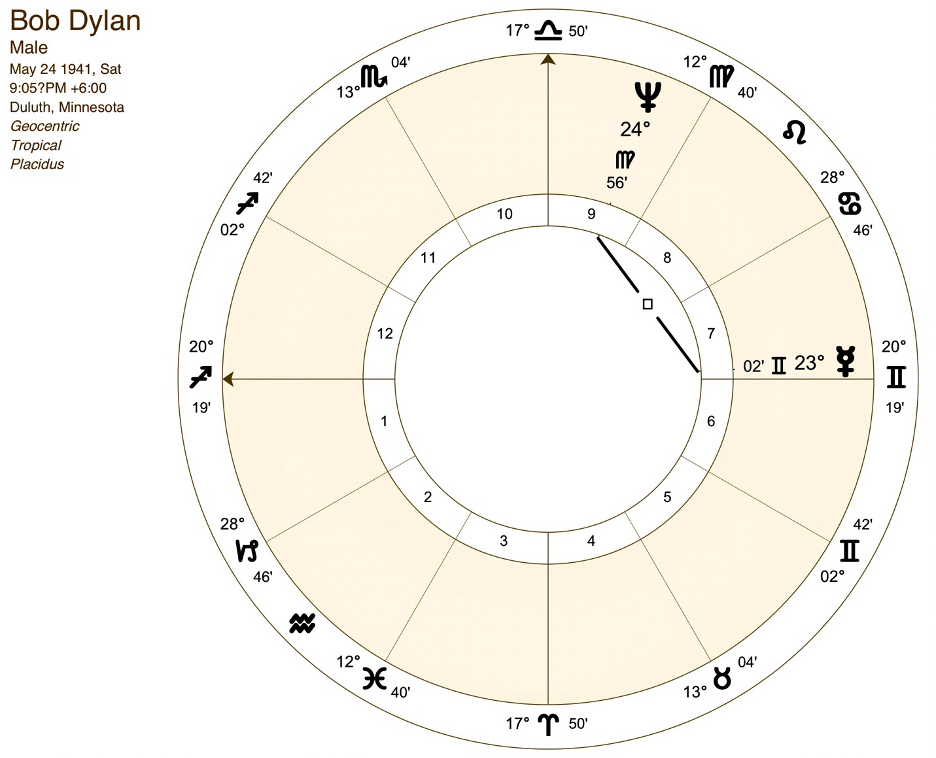 |
I’ve isolated just the Mercury-Neptune square in Dylan’s horoscope, which is amplified exponentially by Mercury’s clos alignment with the angle.
At its best, the inspirational subtlety of Neptune lifts Mercury’s sights toward loftier states of mind and/or spiritual truths, employing ideas and images that “never were but always are” (to paraphrase Sallustius). These are not simple “I love you, you love me” lyrics, rest assured, but something quite different, essentially existing beyond time altogether. Consider these lines from his song “Gates of Eden”:
The kingdoms of Experience
In the precious wind they rot
While paupers change possessions
Each one wishing for what the other has got
And the princess and the prince
Discuss what’s real and what is not
It doesn’t matter inside the Gates of Eden
For Dylan, that Neptunian attraction to higher and/or more abstract truths also explains his talent for seeing beyond the particular to the universal—that is, taking a specific, practical situation and using it to address the timeless or philosophical principles which lie behind it. The most famous example of that is perhaps “Blowing in the Wind,” which stood out from many other protest or anti-war songs of the time by focusing not on any specific conflict (such as the Vietnam War) but on the broader matters of war and peace generally. Similarly, when choosing to write a song about the death of civil rights figure Medgar Evers, “Only a Pawn in their Game,” he sidestepped easy attempts to assign blame solely on the murderer by instead exploring the larger social forces which drive such figures.
The Spigot Opened Wide
Which brings me to my primary focus here—namely, the significance of Neptune’s distant position within our solar system.
As I’ve mentioned in previous Substacks, the vast orbits of the outer, trans-Saturnian planets symbolically speak to their role as points of contact with the masses, to the collective, a feature which led astrologer Dane Rudhyar to call them “ambassadors to the galaxy.” But as the first completely invisible planet in our solar system (from the standpoint of Earthbound observers), Neptune also symbolizes a pipeline to the collective unconscious. Combined with Mercury, it therefore offers the potential of using words to draw upon the riches of that collective wellspring.
We’ve all seen images of kids who have popped open fire hydrants during the hot days of summer, causing geysers of water to flow up and onto city streets. To my mind, Dylan did the equivalent of just that with his lyrics. Using his gift for words, he unleashed a torrent of ideas, symbols, and feelings onto the world stage in a way that hadn’t been seen since the days of James Joyce and books like Ulysses and Finnegans Wake. (Joyce’s horoscope also displays an especially powerful Neptune, unsurprisingly, and even resembles Dylan’s to surprising degree.)
As an example, consider the lyrics to his song “Desolation Row,” composed in the mid-60s during the very peak of a conjunction between two trans-Saturnian “outers,” Uranus and Pluto. Over the course of eleven minutes, he mentions such disparate figures as Ophelia, Cain and Abel, the Hunchback of Notre Dame, Cinderella, Bette Davis, Romeo, Albert Einstein, Robin Hood, the Phantom of the Opera, Casanova, Nero, Ezra Pound, T.S. Eliot, and the Titanic—all mashed together within a single song. Clearly, these are not the highly personal, intimate lyrics of a Joni Mitchell, say, but more like a mouthpiece for the global imagination itself, drawing on humanity’s long traditions of mythology, scripture, literature and pop culture, hand-picked and re-imagined to create new fusions.
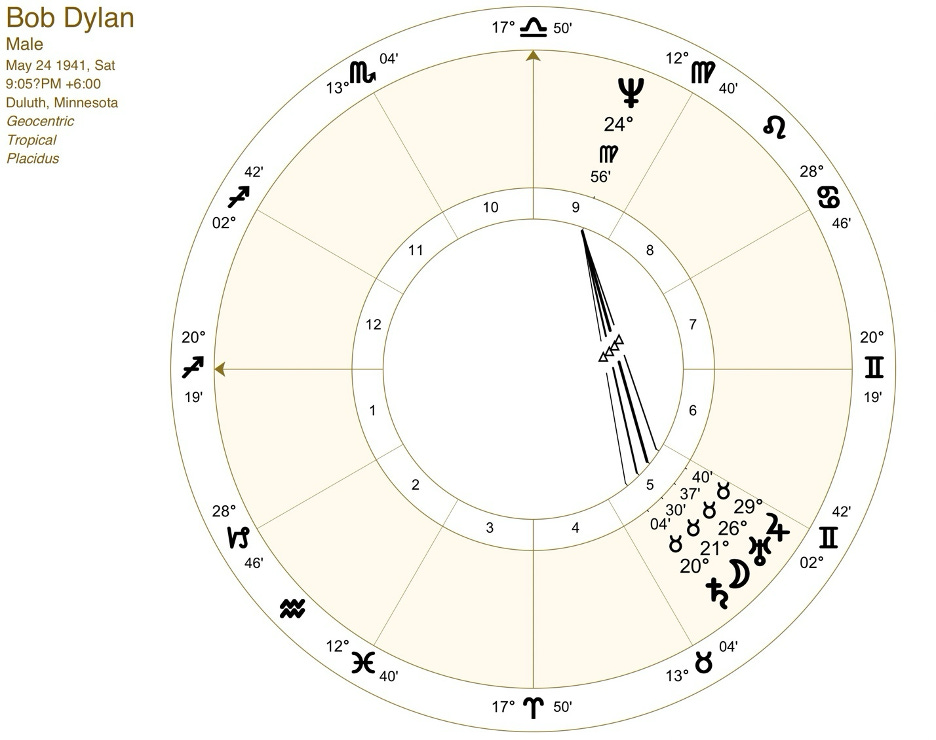 |
Dylan was born in the midst of a rare planetary cluster which included an exceptionally “benefic” pairing of Jupiter and Uranus, both of which were simultaneously forming a harmonious trine to Neptune. I’ve isolated out just those planets in Taurus and Virgo for the sake of this illustration. (As I’ve often pointed out, Orson Welles’ landmark film Citizen Kane also saw its premiere during this unusual configuration, three weeks earlier.)
Because of that global reach implied by the outer planets and their broad orbits, symbolically, Dylan was not only able to access millions of listeners around the world but simultaneously serve as the mouthpiece for many of them. It wasn’t simply the appeal of his surreal imagery or his clever wordplay, but his talent for articulating what so many young people had been feeling at the time. I’m old enough to remember hearing lyrics like, “Come mothers and father throughout the land, and don’t criticize what you can’t understand, your sons and your daughters are beyond your command”—and thinking he was putting into words what many of us were thinking but didn’t quite know how to say ourselves.
In short, a creative talent like Dylan illustrates how a lone individual can sometimes serve as an outlet for the collective unconscious, serving to draw up symbols and ideas from those depths and reformulating them back up to those selfsame masses.
Yet he wasn’t the only example of this phenomenon, of course—nor was the “turf” he staked out the only neighborhood of that collective unconscious to be explored. In this earlier Substack I looked at yet another cultural medium of note, one who drew on an even deeper—and darker—strata of the mass psyche than Dylan.
https://raygrasse.substack.com/p/abducted-by-pluto-gaston-leroux-and
Ray Grasse is a writer, astrologer, and photographer living in the American Midwest. He is author of ten books including The Waking Dream, Under a Sacred Sky, and An Infinity of Gods. His websites are www.raygrasse.com and www.raygrassephotography.com.
#raygrasse#fineartmagazineblog.blogspot.comsunstormfineartmagazine.com#artfunastrology
#artfunnow#artnunlearn#artfunnew,
