Friday, August 21, 2026

The Southampton Arts Center offers the ecologically responsible film~ How to Live on Planet Earth~Special Showing date! with lecture August 27, 2026 5:pm

Actor Benedict Cumberbatch narrates the presentation of ~How to Live on Planet Earth~ within science, human alliances highlighting the human potential to make change and preserve the natural scenic  beauty in the topography displayed. 

Responsible stewardship of the environment needs to be restated  many times as in ~Down to Earth Zac Efron~ and Leonardo DiCaprio's ~Before the Flood~ . I am an environmental activists within the arts. Jamie Forbes, Publisher Fineartmagazineblog.blogspot, and SunStormFineArtMagazine.com, SUNY MFA capstone study project ,  EcoArt- Awareness. https://sites.google.com/view/eco-advocacy/homeBackyardenviornmentalists.com

Ray Grasse's Substack on Bob Dylan~ The Artis as a Conduit to the Collective Unconscious. The Art of Astrology.

Astrology is an interpretive art based in astronomical  mathematics. Ray Grasse brings his genius and warmth to each substack reader delivering perceptive insights as an expert Astrology. If you can read it's easy to understand Ray. Jamie Forbes, Publisher Fineartmagazine blog blogspot.  

https://substack.com/@raygrasse

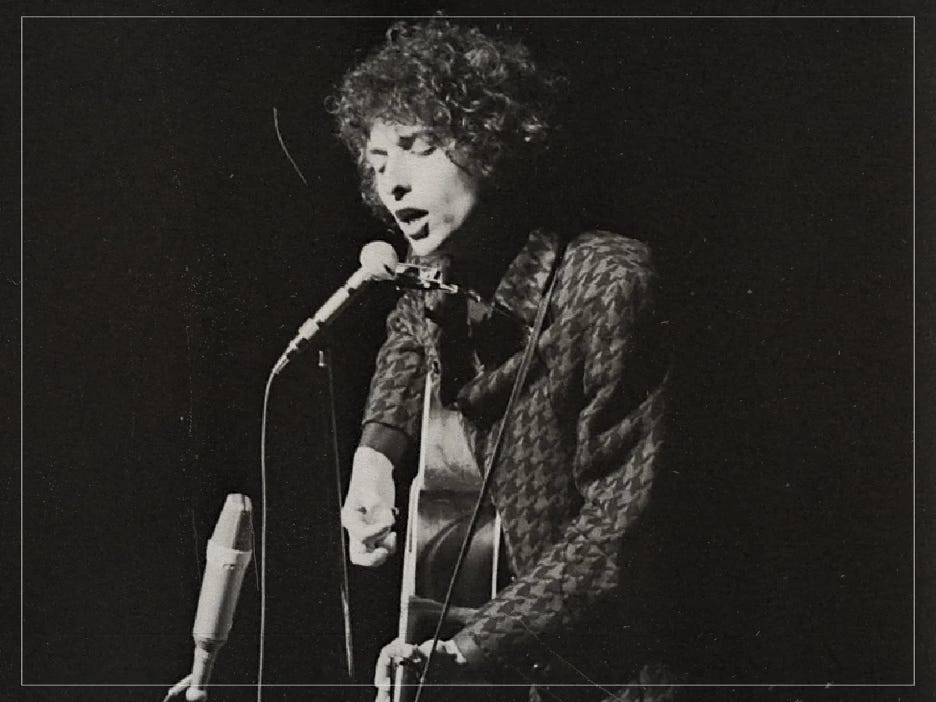
BOB DYLAN ~ THE ARTIST AS CONDUIT TO THE COLLECTIVE UNCONSCIOUS 

Credit: Far Out / Bibliothèque nationale de France

In one of my first astrology classes many years ago, a fellow classmate asked my early astrology teacher, Goswami Kriyananda, the following question: “What shows poetic talent in a horoscope?”

He replied, “You’d have to look at the person’s Mercury, of course.” But he paused a bit then added this: “When it comes to pretty poetry, pleasant poetry, that would be Mercury-Venus. But great poetry? That would be Neptune-Mercury.”

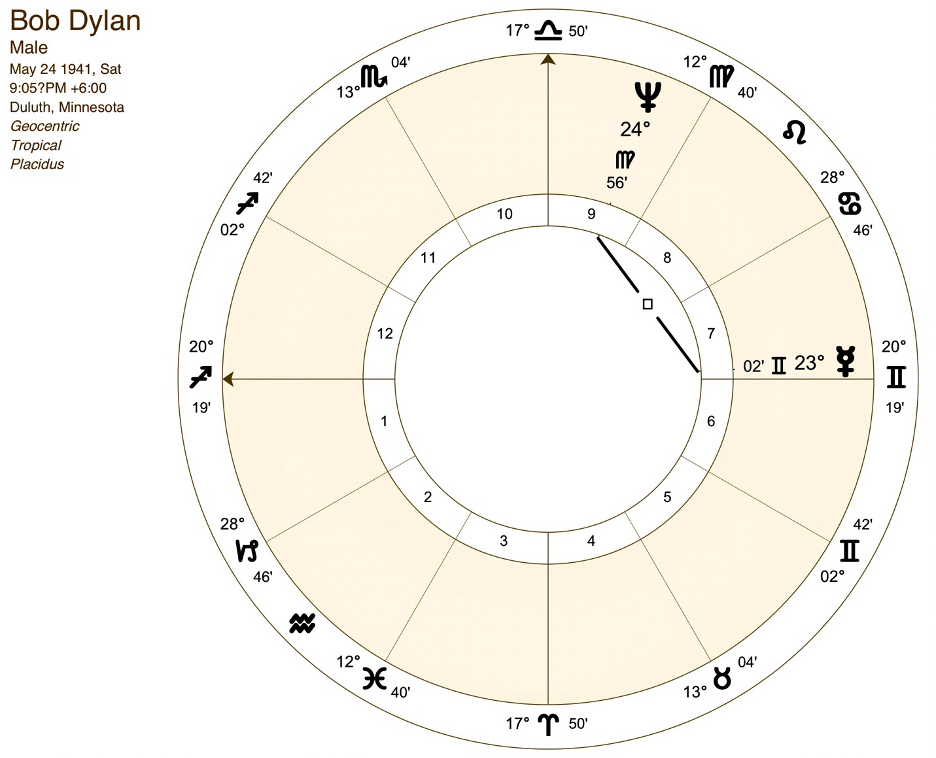
I was intrigued by that, especially since I had just been studying the horoscope of singer Bob Dylan, who happened to be born under a Neptune-Mercury square. The more I thought about that planetary aspect and all the ways it played out in Dylan’s life, the more it elicited a flood of related thoughts and impressions for me.

But first of all, why would Mercury combined with Neptune potentially lend itself to poetic greatness?

By way of contrast, think for a moment of a very different planetary combination like Mercury-Saturn, which is far more concerned with realistic, precisely defined facts. That’s the sort of planetary combination you’d expect to see in the horoscope of journalist, accountant, or scientist, like Isaac Newton (who actually was born with a Mercury-Saturn square). Just the facts, ‘mam, as the old TV series used to put it.

Mercury-Neptune could hardly be any farther from that. Why? Because Neptune is nebulous, amorphous, misty, and doesn’t lend itself to precisely defined explanations or facts. It changes shapes, doesn’t reman fixed for long, and is quite comfortable with surrealism, fantasy, fiction, melting watches, and double-meanings.

As a result, when Neptune is combined with Mercury it can result in an imprecise, even slippery relationship with truth, less like a science text than a book of poetry, fantasy novel, or a series of tall tales. (I can think of one or two current U.S. politicians with the Neptune-Mercury square, in fact, who seem to have an especially loose relationship with the truth—but I digress.)

But while that can indeed be problematic at times, that slipperiness and nebulousness is also the very thing which, in the right hands, opens it up to profound possibilities and creative ambiguities. The Neptune-Mercury combo can communicate ideas and truths which are not fixed or one-dimensional, and are instead open to multiple meanings and layers of inference.

When Dylan wrote “Crimson flames tied through my ears, rollin’ high and mighty traps,” no one had a clue what it meant, but it didn’t really matter, because he was speaking poetic truth, not literal truth. Or consider the line, “Darkness at the break of noon, shadows even the silver spoon, a hand-made blade, a child’s balloon, eclipses both the sun and moon, you understand you know too soon, there is no sense in trying.” Here as well, the words made no sense at all to the rational mind, but it nonetheless spoke to the subconscious.

I’ve isolated just the Mercury-Neptune square in Dylan’s horoscope, which is amplified exponentially by Mercury’s clos alignment with the angle.

At its best, the inspirational subtlety of Neptune lifts Mercury’s sights toward loftier states of mind and/or spiritual truths, employing ideas and images that “never were but always are” (to paraphrase Sallustius). These are not simple “I love you, you love me” lyrics, rest assured, but something quite different, essentially existing beyond time altogether. Consider these lines from his song “Gates of Eden”:

The kingdoms of Experience
In the precious wind they rot
While paupers change possessions
Each one wishing for what the other has got
And the princess and the prince
Discuss what’s real and what is not
It doesn’t matter inside the Gates of Eden

For Dylan, that Neptunian attraction to higher and/or more abstract truths also explains his talent for seeing beyond the particular to the universal—that is, taking a specific, practical situation and using it to address the timeless or philosophical principles which lie behind it. The most famous example of that is perhaps “Blowing in the Wind,” which stood out from many other protest or anti-war songs of the time by focusing not on any specific conflict (such as the Vietnam War) but on the broader matters of war and peace generally. Similarly, when choosing to write a song about the death of civil rights figure Medgar Evers, “Only a Pawn in their Game,” he sidestepped easy attempts to assign blame solely on the murderer by instead exploring the larger social forces which drive such figures.

The Spigot Opened Wide

Which brings me to my primary focus here—namely, the significance of Neptune’s distant position within our solar system.

As I’ve mentioned in previous Substacks, the vast orbits of the outer, trans-Saturnian planets symbolically speak to their role as points of contact with the masses, to the collective, a feature which led astrologer Dane Rudhyar to call them “ambassadors to the galaxy.” But as the first completely invisible planet in our solar system (from the standpoint of Earthbound observers), Neptune also symbolizes a pipeline to the collective unconscious. Combined with Mercury, it therefore offers the potential of using words to draw upon the riches of that collective wellspring.

We’ve all seen images of kids who have popped open fire hydrants during the hot days of summer, causing geysers of water to flow up and onto city streets. To my mind, Dylan did the equivalent of just that with his lyrics. Using his gift for words, he unleashed a torrent of ideas, symbols, and feelings onto the world stage in a way that hadn’t been seen since the days of James Joyce and books like Ulysses and Finnegans Wake. (Joyce’s horoscope also displays an especially powerful Neptune, unsurprisingly, and even resembles Dylan’s to surprising degree.)

As an example, consider the lyrics to his song “Desolation Row,” composed in the mid-60s during the very peak of a conjunction between two trans-Saturnian “outers,” Uranus and Pluto. Over the course of eleven minutes, he mentions such disparate figures as Ophelia, Cain and Abel, the Hunchback of Notre Dame, Cinderella, Bette Davis, Romeo, Albert Einstein, Robin Hood, the Phantom of the Opera, Casanova, Nero, Ezra Pound, T.S. Eliot, and the Titanic—all mashed together within a single song. Clearly, these are not the highly personal, intimate lyrics of a Joni Mitchell, say, but more like a mouthpiece for the global imagination itself, drawing on humanity’s long traditions of mythology, scripture, literature and pop culture, hand-picked and re-imagined to create new fusions.

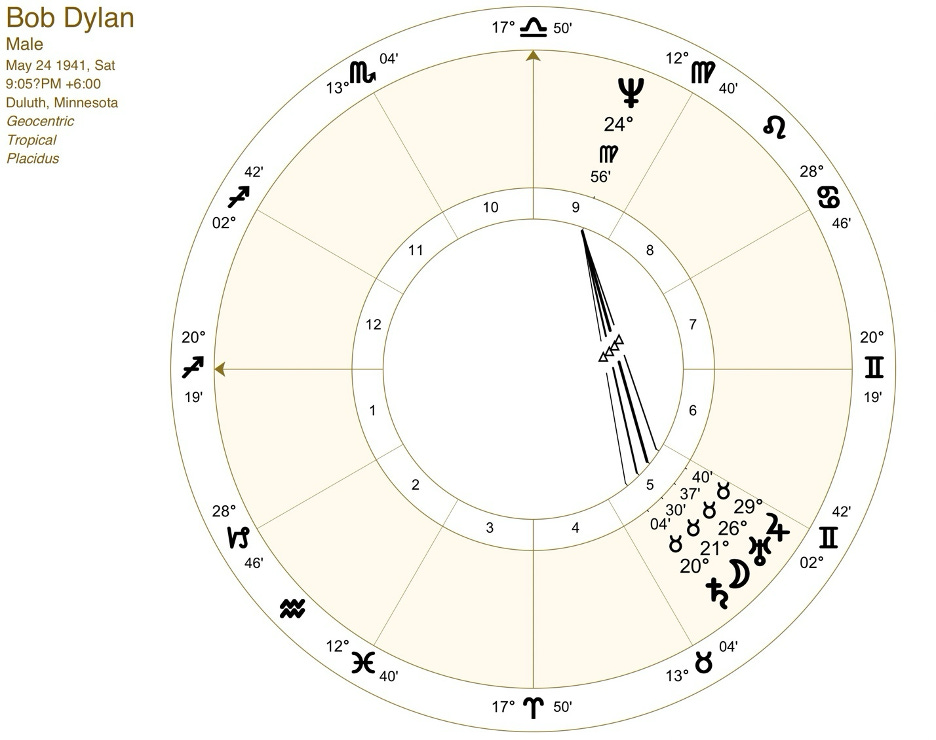
Dylan was born in the midst of a rare planetary cluster which included an exceptionally “benefic” pairing of Jupiter and Uranus, both of which were simultaneously forming a harmonious trine to Neptune. I’ve isolated out just those planets in Taurus and Virgo for the sake of this illustration. (As I’ve often pointed out, Orson Welles’ landmark film Citizen Kane also saw its premiere during this unusual configuration, three weeks earlier.)

Because of that global reach implied by the outer planets and their broad orbits, symbolically, Dylan was not only able to access millions of listeners around the world but simultaneously serve as the mouthpiece for many of them. It wasn’t simply the appeal of his surreal imagery or his clever wordplay, but his talent for articulating what so many young people had been feeling at the time. I’m old enough to remember hearing lyrics like, “Come mothers and father throughout the land, and don’t criticize what you can’t understand, your sons and your daughters are beyond your command”—and thinking he was putting into words what many of us were thinking but didn’t quite know how to say ourselves.

In short, a creative talent like Dylan illustrates how a lone individual can sometimes serve as an outlet for the collective unconscious, serving to draw up symbols and ideas from those depths and reformulating them back up to those selfsame masses.

Yet he wasn’t the only example of this phenomenon, of course—nor was the “turf” he staked out the only neighborhood of that collective unconscious to be explored. In this earlier Substack I looked at yet another cultural medium of note, one who drew on an even deeper—and darker—strata of the mass psyche than Dylan.

https://raygrasse.substack.com/p/abducted-by-pluto-gaston-leroux-and

Ray Grasse is a writer, astrologer, and photographer living in the American Midwest. He is author of ten books including The Waking Dream, Under a Sacred Sky, and An Infinity of Gods. His websites are www.raygrasse.com and www.raygrassephotography.com.

#raygrasse#fineartmagazineblog.blogspot.comsunstormfineartmagazine.com#artfunastrology

#artfunnow#artnunlearn#artfunnew,


Thursday, August 20, 2026

DIB Bangkok Celebrates Alexander Calder's Circus 100th Anniversary with ~Giving of Life~ on exhibition September 26, 2026

 DID Bangkok delivers A multi generational group of artist cutated with in the focus of Alexander Calder's  work. On display September 26, 2026. See details below

DIB BANGKOK CELEBRATES THE CENTENARY OF ALEXANDER CALDER’S CIRCUS WITH GIVING LIFE EXHIBITION
ON VIEW FROM SEPTEMBER 26, 2026

Following the museum’s December 2025 debut, Giving Life extends the inaugural energy through a transgenerational group exhibition, placing Alexander Calder in dialogue with Izumi Kato, Caitlin Keogh, Sutee Kunavichayanont, Surasi Kusolwong, Tuan Andrew Nguyen, Tobias Rehberger, Vasan Sitthiket, Rirkrit Tiravanija, Yukinori Yanagi, and Rachel Youn, among others.
Alexander Calder, Untitled, 1963. One of two works on view at Dib Bangkok. © 2026 Calder Foundation, New York / Artists Rights Society (ARS), New York 
(August 19, 2026, Bangkok, Thailand) | Dib Bangkok announces Giving Life ชีวิต ชีวา(pronounced chiwit chiwa), a transgenerational group exhibition of 160 works by 33 international and Thai artists curated by Ariana Chaivaranon. On view from September 26, 2026 to May 3, 2027, this exhibition explores how art is animated across time, bringing together artists who imbue inanimate materials with life and create works that move, respond, and transform in relation to our physical environments and historical contexts. Anchored by Alexander Calder’s landmark works, Giving Life brings Calder’s pioneering explorations of movement and transformation into dialogue with international contemporary artists including Izumi Kato, Caitlin Keogh, Tuan Andrew Nguyen, Tobias Rehberger, Yukinori Yanagi, and Rachel Youn, alongside Thai artists Sutee Kunavichayanont, Surasi Kusolwong, Vasan Sitthiket, and Rirkrit Tiravanija, among others.

Suggesting movement and new beginnings, the title reflects Dib Bangkok’s vision of the museum as a living organism, shaped through collective care as it grows. Giving Life ชีวิต ชีวา also marks fifty years since the passing of Alexander Calder and channels the joy, hope, and dynamic life force that his pioneering experiments brought to the forefront of modern art. Positioning this highly influential artist as an anchoring point, the exhibition’s curatorial narrative invites audiences to encounter uniquely animated works that appear to breathe, move, react, and transform, unpacking new ways of seeing the world.

Giving Life also highlights a pivotal moment in Thailand’s contemporary art history during the final months of the Vietnam War, when Alexander Calder’s 1975 exhibition Calder’s Circus at the Bhirasri Institute of Modern Art marked the first presentation of his work in Thailand. This moment coincided with the return of a generation of Thai artists from abroad, who introduced new approaches to abstraction, installation, and performance, reshaping the country’s artistic landscape. An archive of more than 60 historical materials traces these artistic exchanges and Calder’s influence on the development of experimental practices in Thailand. Featuring artists including Vasan Sitthiket, Surasi Kusolwong, Sutee Kunavichayanont, Somboon Hormtientong, and others, this section reflects on how Thai artists expanded the possibilities of sculpture, installation, performance, and socially engaged practice. Emerging amid broader social and political change, these practices advanced a vision of “art for life,” expanding the role of art beyond traditional forms and into wider society.
 (Left) Rirkrit Tiravanija, untitled 2007 (mussels corner 1), 2007. Photo credit: Sebastiano Pellion.
(Right) Yukinori Yanagi, Cubism and Abstract Art, 2012. Courtesy of Dib Bangkok.

 
Across the exhibition, international and Thai artistic practices enter into dialogue through shared explorations of movement, animation, and transformation. The galleries bring together works by artists who activate materials in unexpected ways, from Paul Chan’s inflatable and animated Breather series and Izumi Kato’s freestanding paintings, to Rachel Youn’s sculptures constructed from recycled machines and Caitlin Keogh’s monumental Procession series. Tuan Andrew Nguyen’s works made from unexploded ordnance explore histories of conflict and regeneration, while works by Rirkrit Tiravanija, Ryan Gander, Cecilia Vicuña, and Kei Imazu further expand ideas of interaction, participation, and material life. Additional highlights include interactive elements throughout the exhibition, including a breathing white elephant sculpture based on Sutee Kunavichayanont’s Elephant (Breath Donation) (1998–2001), inviting audiences to actively participate in the process of giving life to artworks. A dedicated screening room and the archival presentation further extend the exhibition’s exploration of moving image, historical documents, and primary sources.

The exhibition’s public programs will extend these ideas into live encounters, including recurring movement performances engaging with works by Paul Chan, Cecilia Vicuña, and Rachel Youn. Through sculpture, installation, performance, moving image, and archival material, Giving Life explores how artists continue to animate matter, engage audiences, and reveal the unseen forces connecting objects, bodies, and histories across time. 


Ariana Chaivaranon, Curator, states: “Artists are people who bring matter to life. They take the stuff of the world and infuse it with ideas that can live beyond us, impacting people across time and space. Today, we are having urgent conversations about creativity, consciousness, and agency. The artworks in this exhibition take on lives of their own—they move, react, and transform in relation to our physical and historical contexts. They mirror the textured and variegated experiences of our own lives—how we perform, labor, play, and express ourselves. Refusing to stay still, they remind us of the most constant state of life: change.
Tuan Andrew Nguyen, Tremor, 2025. Courtesy the artist, James Cohan, New York. Photo by Dan Bradica.
 
(Left) Caitlin Keogh, Procession, 2024. (Right) Izumi Kato, Untitled, 2018. Photo by Yusuke Sato [Text Wrapping Break]©2018 Izumi Kato, courtesy of the artist and Perrotin 
Vasan Sitthiket,​ Inferno (นิรยกถา (บาปตัดไม้ทำลายป่า))​, 1991. Courtesy by Dib Bangkok. 
The inaugural exhibition (In)visible Presence, on view from December 2025 to August 2026, reflected Dib Bangkok’s roots, honoring the long-held vision of its founding collector and the earlier artistic communities who contributed to establishing the museum. Giving Life embodies the vitality of the present moment, resonating with Bangkok’s rapidly expanding cultural landscape. It continues Dib Bangkok’s exploration of the intersection between local histories and global perspectives.
 
Dr. Miwako Tezuka, Director, describes her artistic direction behind Giving Life: “At Dib Bangkok, each exhibition is conceived as part of an unfolding narrative, where one chapter leads to the next. Giving Life continues this trajectory by exploring movement, transformation, and the conditions that animate art in the present. Within the context of the development of Thai contemporary art, it also reflects on a pivotal historical shift in the 1970s that coincided with the introduction of works by Alexander Calder and expanded the possibilities of art towards performance, installation, and interaction. Rather than presenting a fixed interpretation, we approach each exhibition as a proposition—one thread within a larger, continuous narrative. From a Thai perspective, this allows us to situate local histories within broader global conversations, contributing to a more layered and diverse understanding of contemporary art.”

Purat “Chang” Osathanugrah, Founding Chairman, concludes: “Dib is a living institution—evolving with its collection, its audiences, and the cultural moment it inhabits. With Giving Life, we bring that evolution into focus, reflecting the museum’s growing depth and direction. We continue this mission by building Dib as a platform to cultivate patrons, empower creatives, and strengthen the artistic ecosystem—part of a broader responsibility to serve as a civic institution for Bangkok while connecting local perspectives to a global dialogue. This next chapter brings even more vibrancy into Dib—inviting curiosity, creativity, and a sense of unexpected joy.”
 
Giving Life will be on view at Dib Bangkok from September 26, 2026 to May 3, 2027.

Dib Bangkok. Photo by Tanatip Chawang

#didbangkokexhibition#fineartmagazineblog.blogspot.com #sunstormfineartmagazine.com#artfunbangkok#artfuncalder#artfunnow#artfunnew