 Cheech Marin Center for Chicano Art & Culture of the Riverside Art Museum – Riverside
Visited: December 2022
Tracy and I have been fortunate to have visited some great art museums throughout the years, but we have also visited some duds. We did not know what to expect when we drove out to see the Cheech Marin Center for Chicano Art & Culture (“The Cheech”), and we came away absolutely “wowed” by what we had just witnessed. (link to Tracy’s 30-second introductory video)
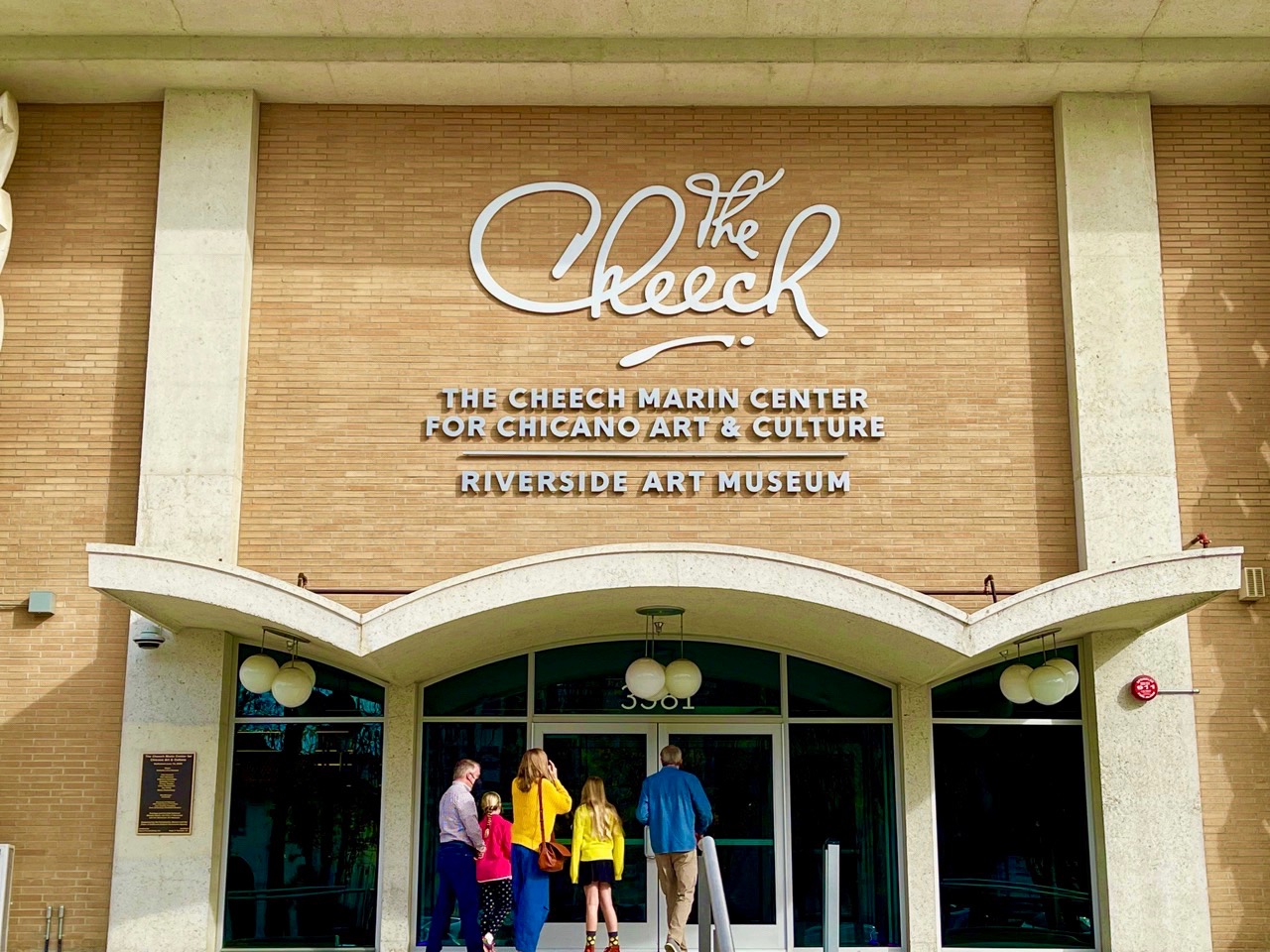
In
our travels, we have experienced art at various types of museums,
palaces, castles, churches and cathedrals, and while we are certainly
not experts by a loooong shot, we are enthusiastic about what we like.
And one thing that always calls to us is color… from the deep saturated
colors of Renaissance art, to dazzling mosaics, to edgy and vibrant
street art like we saw recently in Coimbra, Portugal.
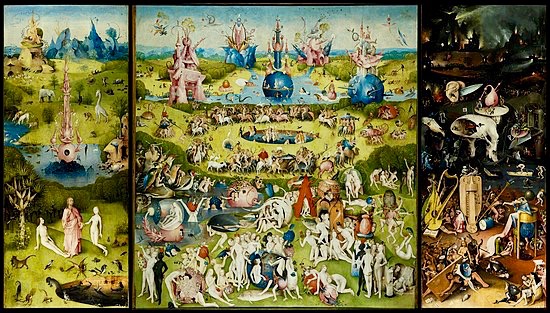
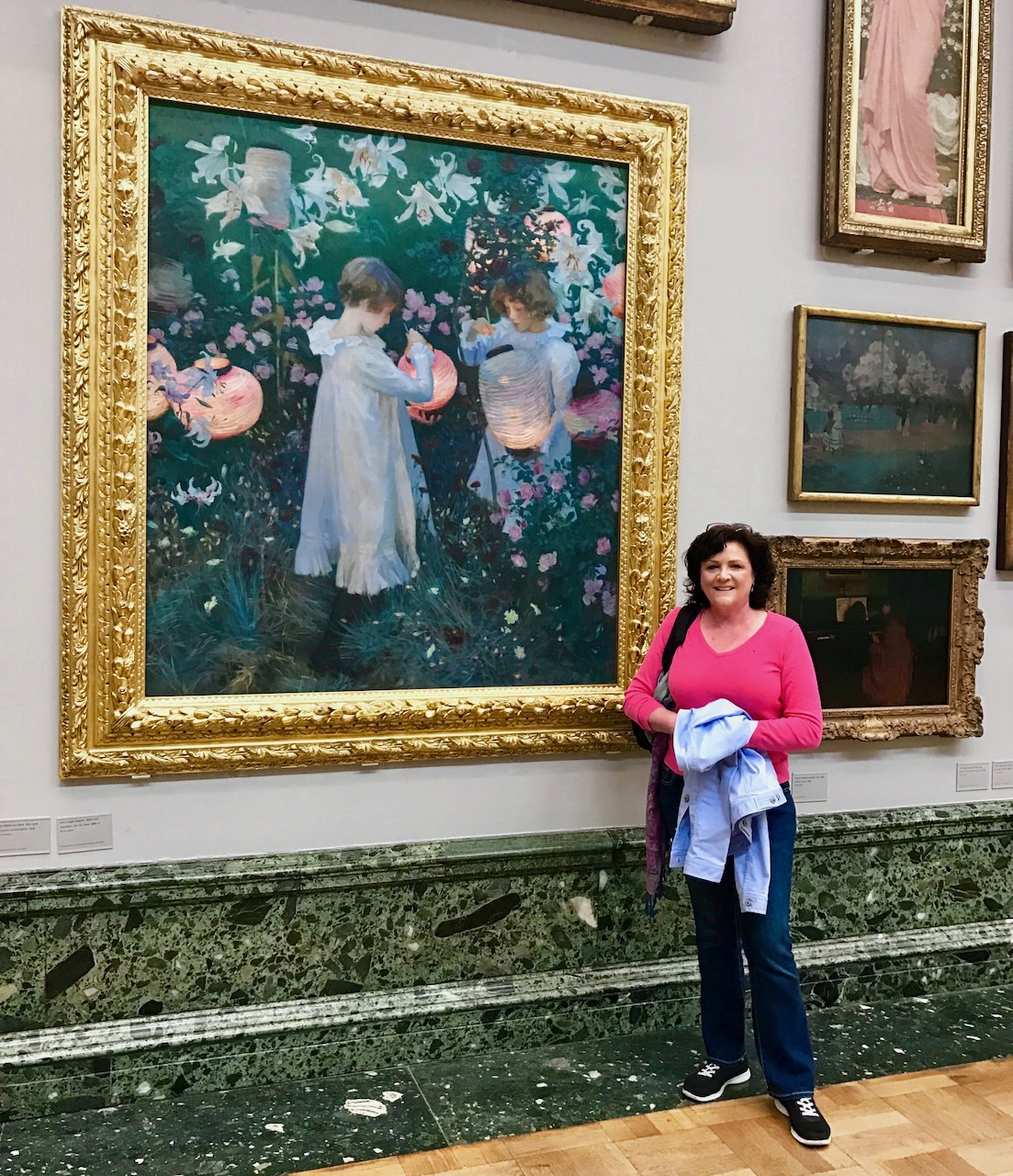
My current favorite piece of art is Hieronymus Bosch’s (aka “El Bosco”) “The Garden of Earthly Delights,” (so I definitely like edgy) which I marveled at in the Prado in Madrid; while Tracy’s current favorite artist is John Singer Sargent and in particular, “Carnation, Lily, Lily, Rose” which resides at the Tate Britain in London (photo on left from internet).
When
we learned that Cheech Marin (of Cheech and Chong, along with Nash
Bridges, fame) had collaborated with the city of Riverside to open a
museum of his extensive collection of Chicano art, we decided to check
it out with friends Alex and Valerie.
From an ARTnews article with Cheech Marin about his collection, “Marin
had his first meaningful encounter with Chicano art in the mid-1980s,
at an L.A. gallery. Marin said, ’It was familiar and different at the
same time. It was like hearing the Beatles for the first time: I’ve
heard this music before, but not quite this way.’” The
article stated that Marin had always been interested in collecting,
from baseball cards as a kid to Art Noveau as a young adult. In the
1980s that all changed. According to the article, “It wasn’t until
the 1980s that Chicano Art showed up on his collection radar, and his
first purchases included by George Yepes, Frank Romero, and Carlos
Almaraz.” The article went on to say, “He soon developed what
he jokingly calls a ‘mania.’ ‘The art was so intriguing and so good that
I couldn’t help but keep on going. Just when you thought you’d seen it
all, here comes another work.’ His collection now numbers some 700
pieces, and is widely considered the largest collection of Chicanx art
in private or public hands.” (“La Noche Buena” by Ricardo Ruiz below)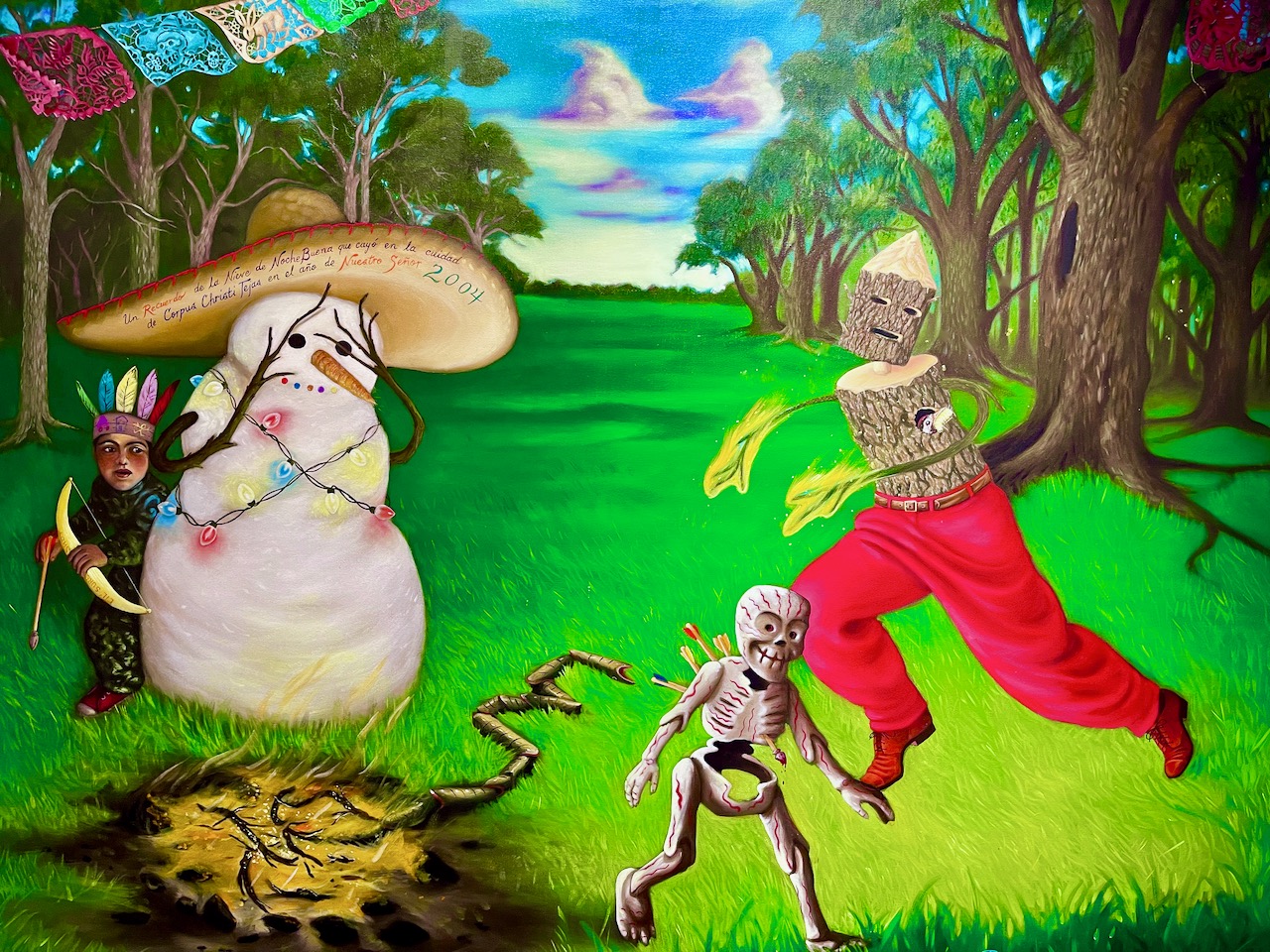
The
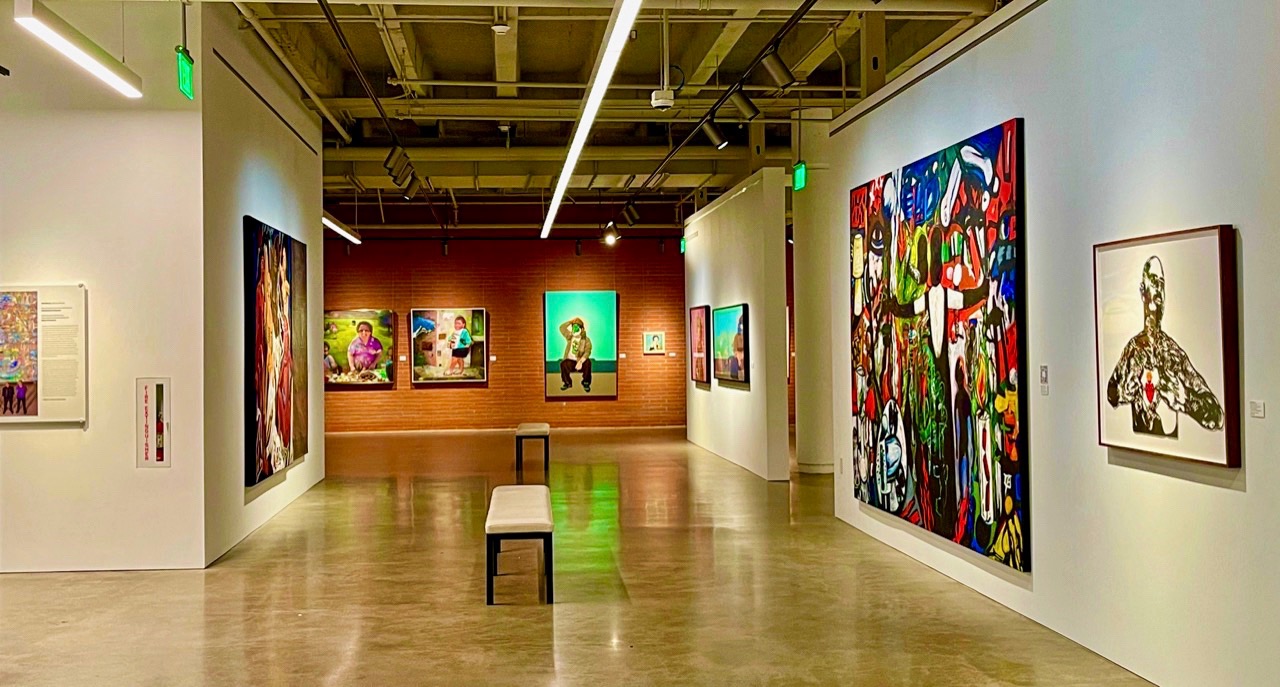
City of Riverside spent $13 million renovating a former public library
just for this collection. The modern building is the perfect backdrop
for this colorful and interesting collection of paintings, drawings,
sculptures and many unique art forms. (I have to give a shout out to
whoever renovated this museum, it is spacious and, unlike so many art
museums, the lighting is perfect. No glare on the paintings from
overhead lighting or dim shadows which unfortunately we find in many
museums.) I can see why Marin agreed to this collaboration as the works
range in size from small to gigantic. (Carlos Donjuán’s “Nasty Nez” below) 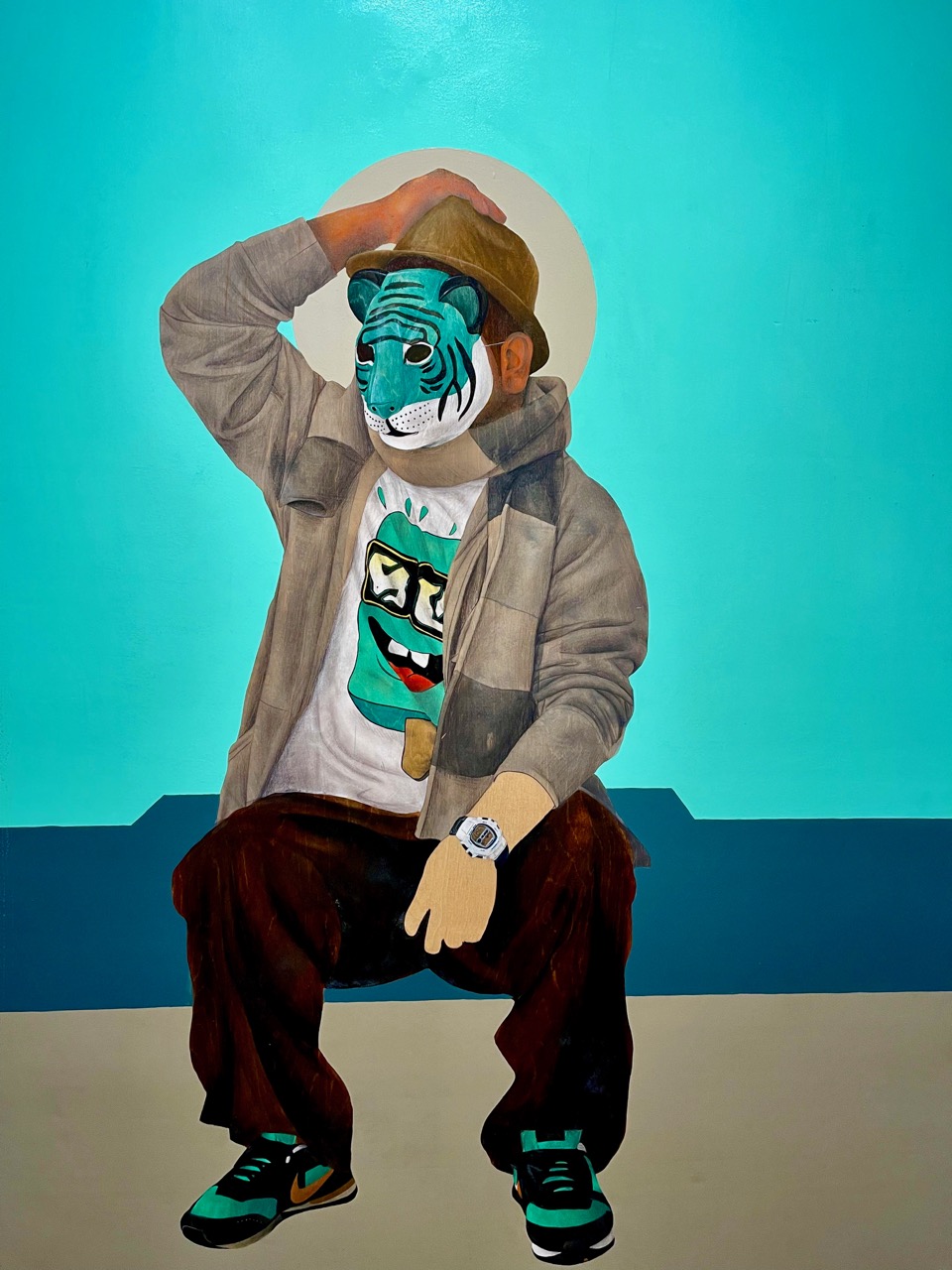
Opening in June 2022, there are currently 90 art works on display including an eclectic temporary exhibit called “Collidoscope”
by the artist brother team of Einar and Jamex de la Torre (which
unfortunately closes on January 22, 2023). The exhibit will embark on a
national tour supported by the Smithsonian’s National Museum of the
American Latino in 2023, but if you get the chance in the next couple of
weeks check it out at The Cheech.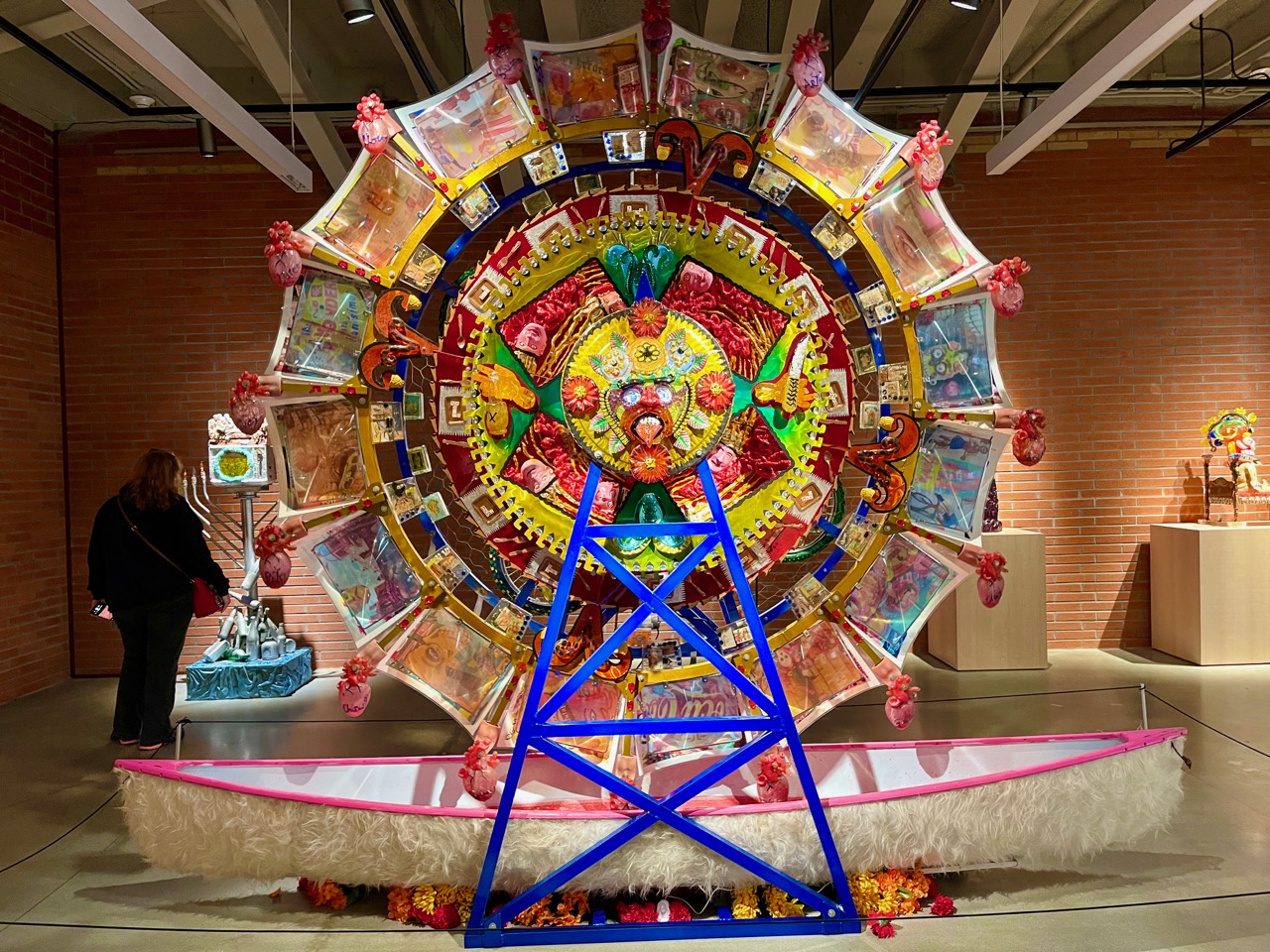
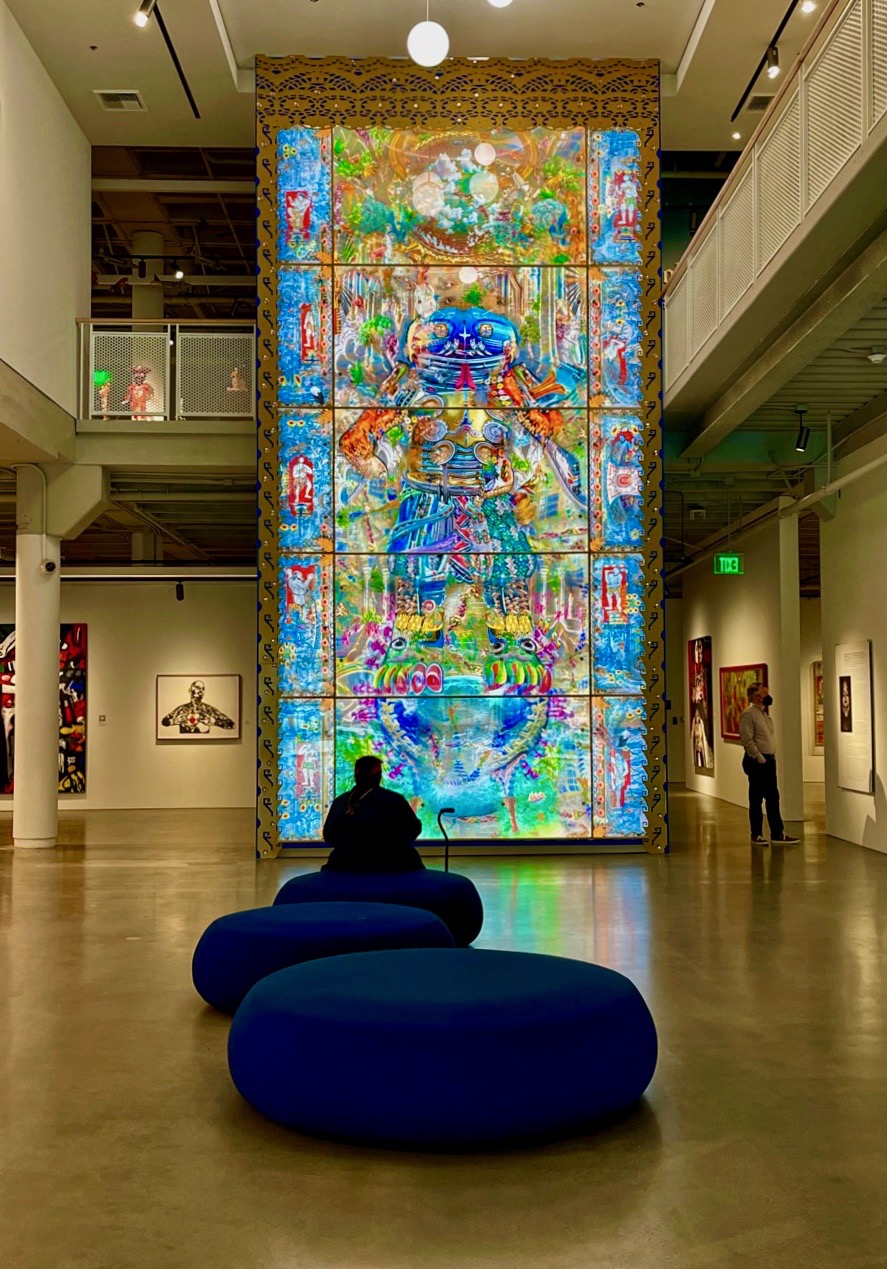
In the main lobby is a 26-foot tall lenticular installation commissioned from the de la Torre brothers. When you first view it, it appears to be stained glass, but as you move around it shape-shifts. I had to look up lenticular, but if you recall the post cards you had as a kid that changed as you tilted them, that is what this piece does, appearing to transfer from an Aztec goddess to a transformer-like machine as you move around it.

The signage in the museum is in both English and Spanish, and there are QR codes for many of the artworks which feature Marin talking about that specific piece. Cool idea! I wish there was a short movie about Mr. Marin and his collection on the premises, and hopefully that will be in the future. Ok, on to just a small portion of the fantastic art we witnessed!
Marin is very much into promoting local artists, and these two pieces from Olivia Flores (left) and Cesar Aguilar immediately caught our early attention.
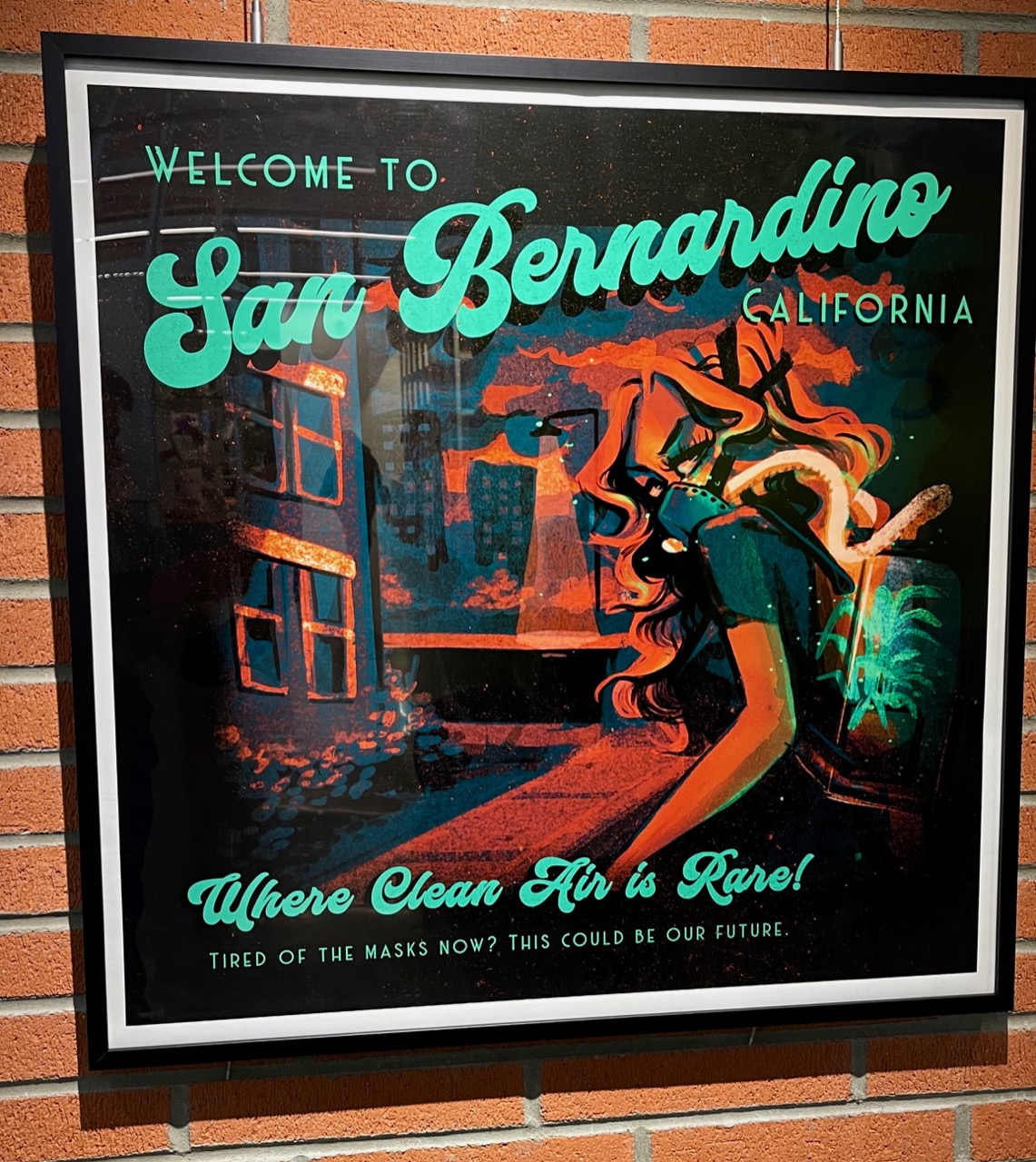
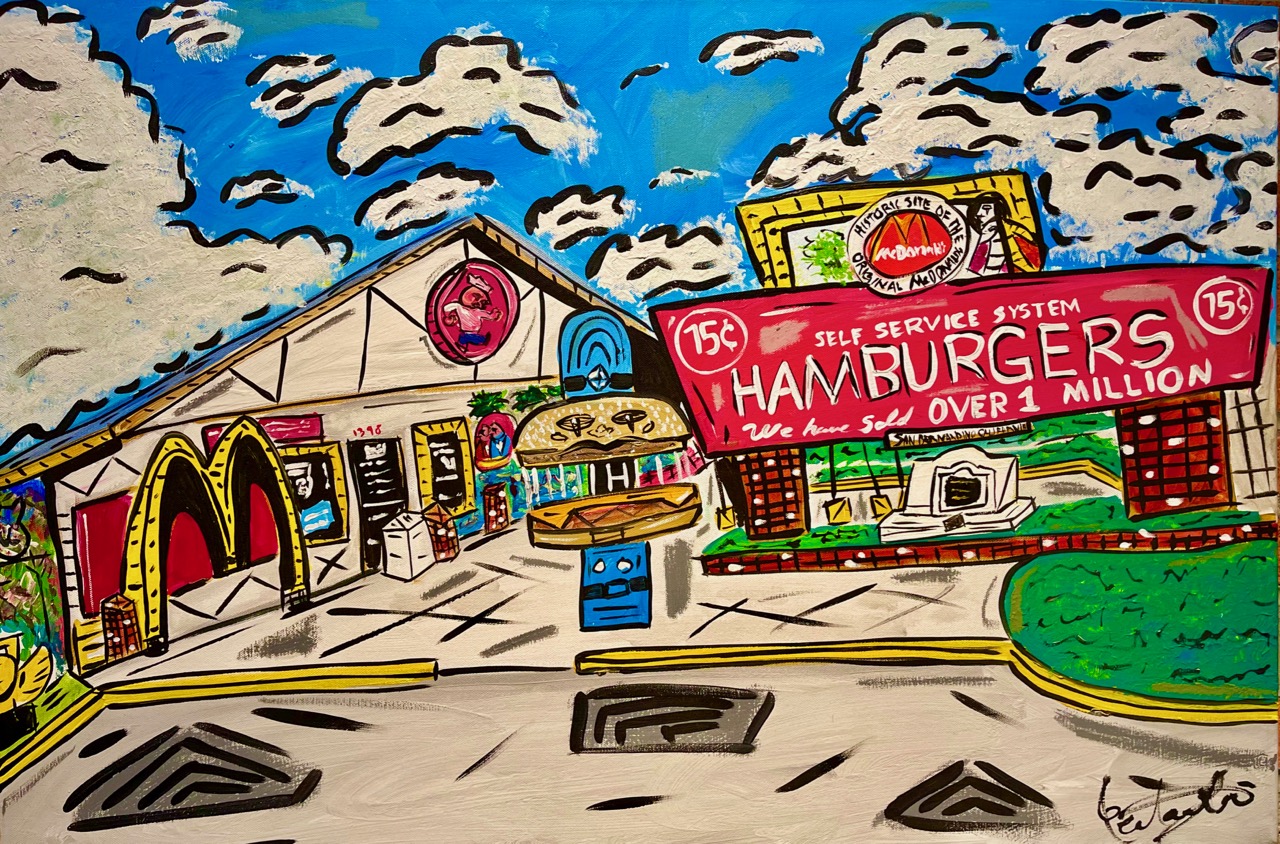
From Marin’s private collection, the first one we saw was by artist Frank Romero, “The Arrest of the Palateros.”
The painting depicts the paleteros (or ice-cream men) being arrested in
Echo Park for not having vendor permits. Romero was the first Chicano
artist to show his paintings at LACMA (Los Angeles County Museum of
Art), and is one of pioneers of the Chicano art movement.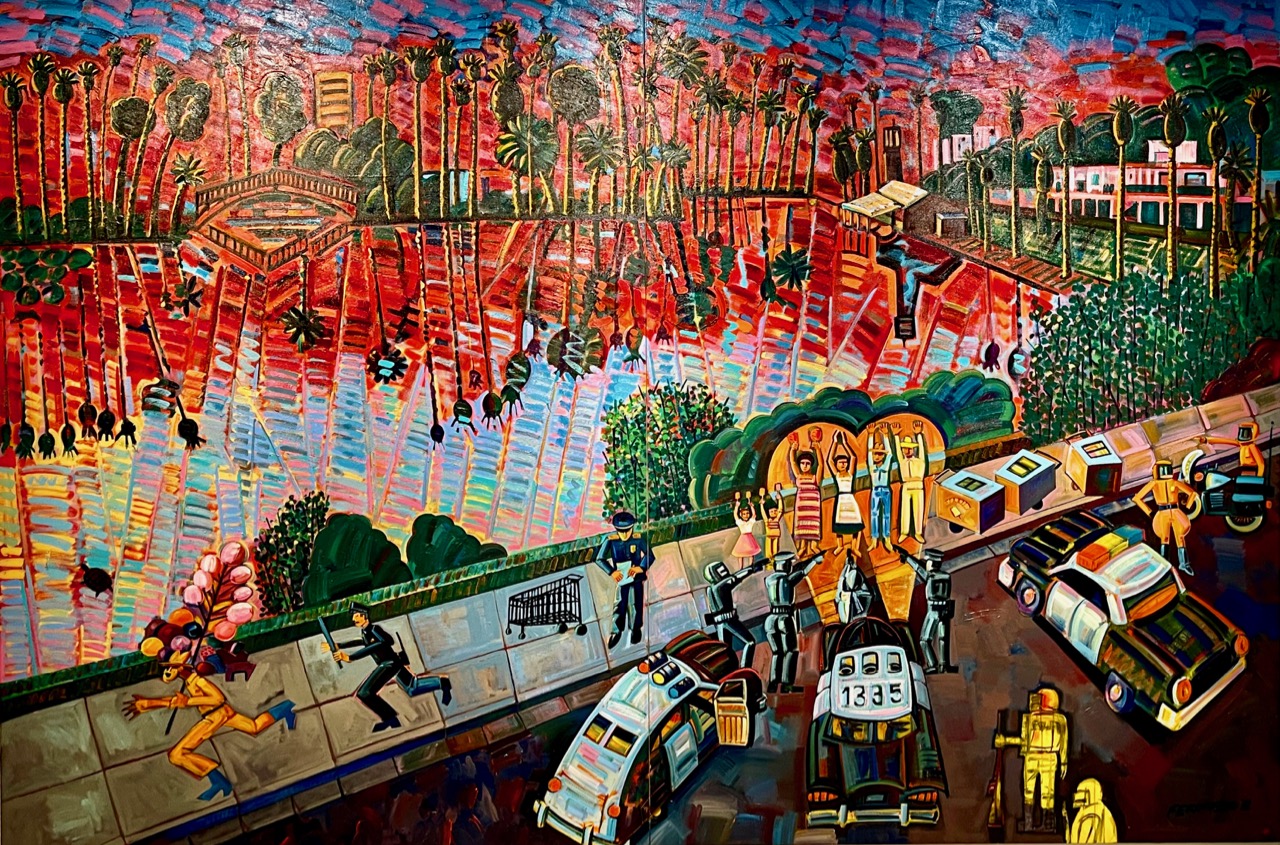
Jacinto
Guevara grew up in East L.A., but has lived in East San Antonio since
the early 1990s. He drew inspiration from East L.A.’s colorful murals.
He lives on Olive Street in San Antonio, which not so coincidentally is
the name of this painting.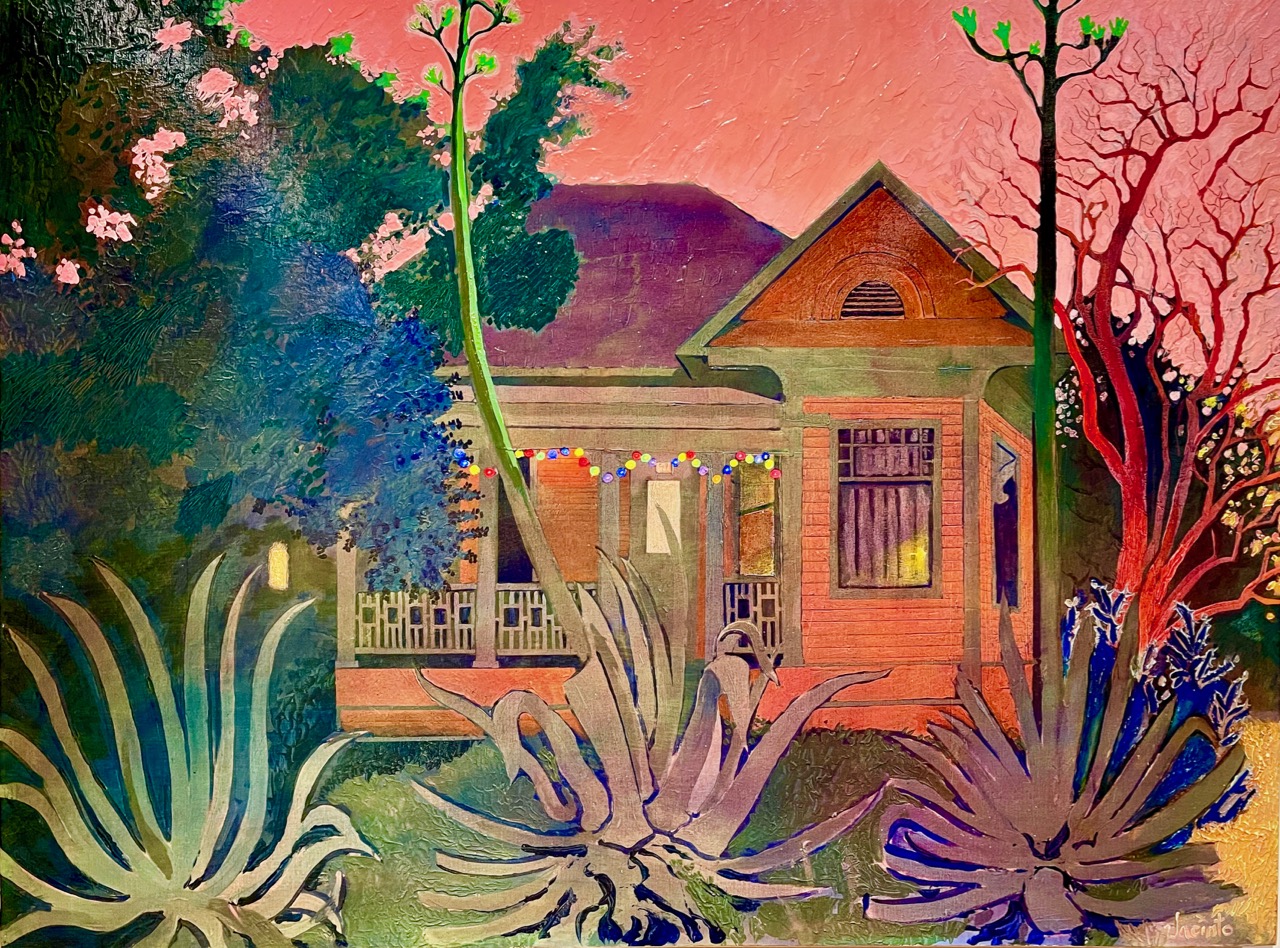
Joe Peña was born in Laredo, Texas, and eventually became an Associate Professor of Art with a concentration in Painting at the university. Three of his series of the “The Last Stop: Nightscape” paintings are at The Cheech. You can never go wrong with elote or tamales late at night (or anytime).
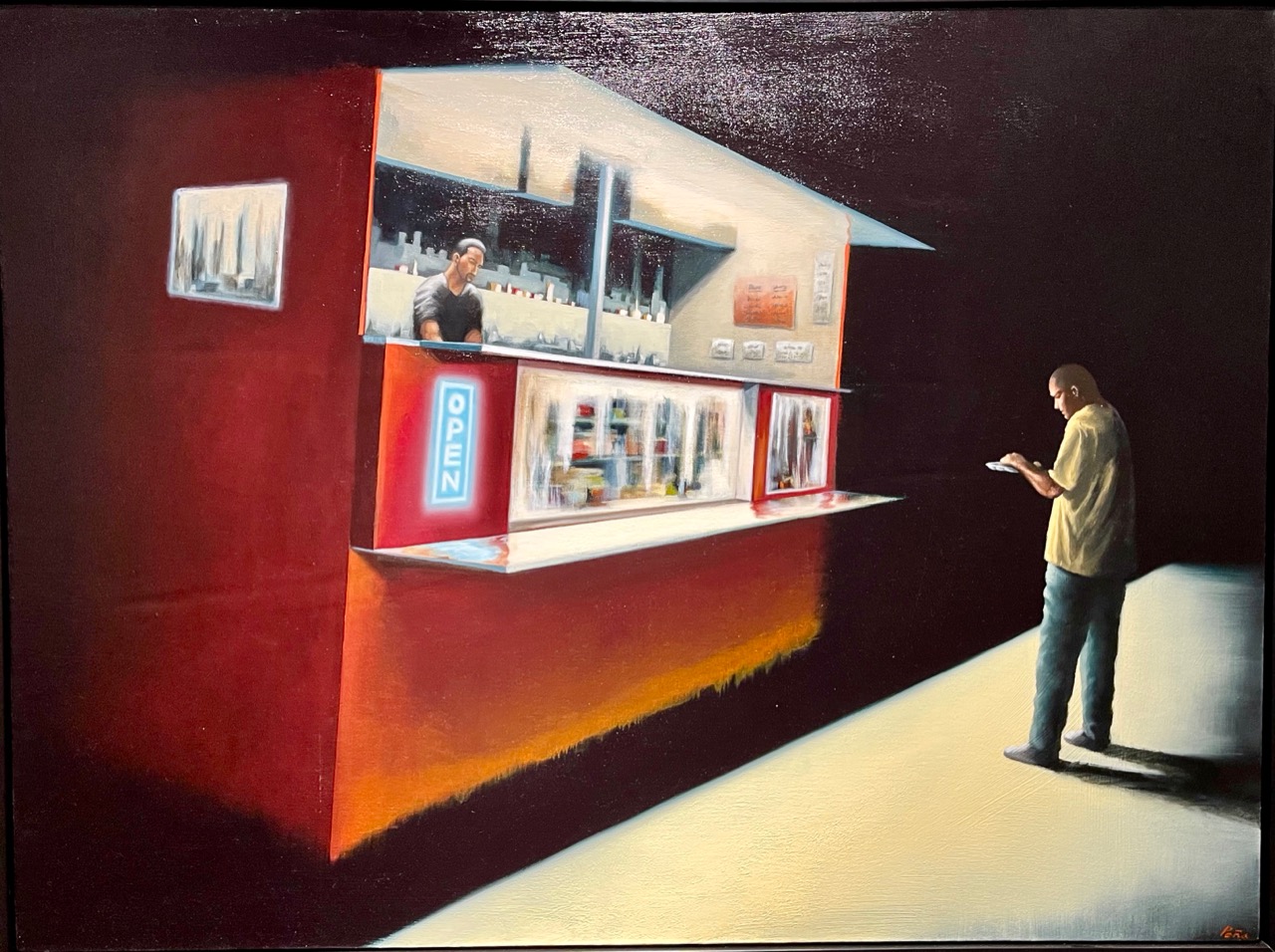
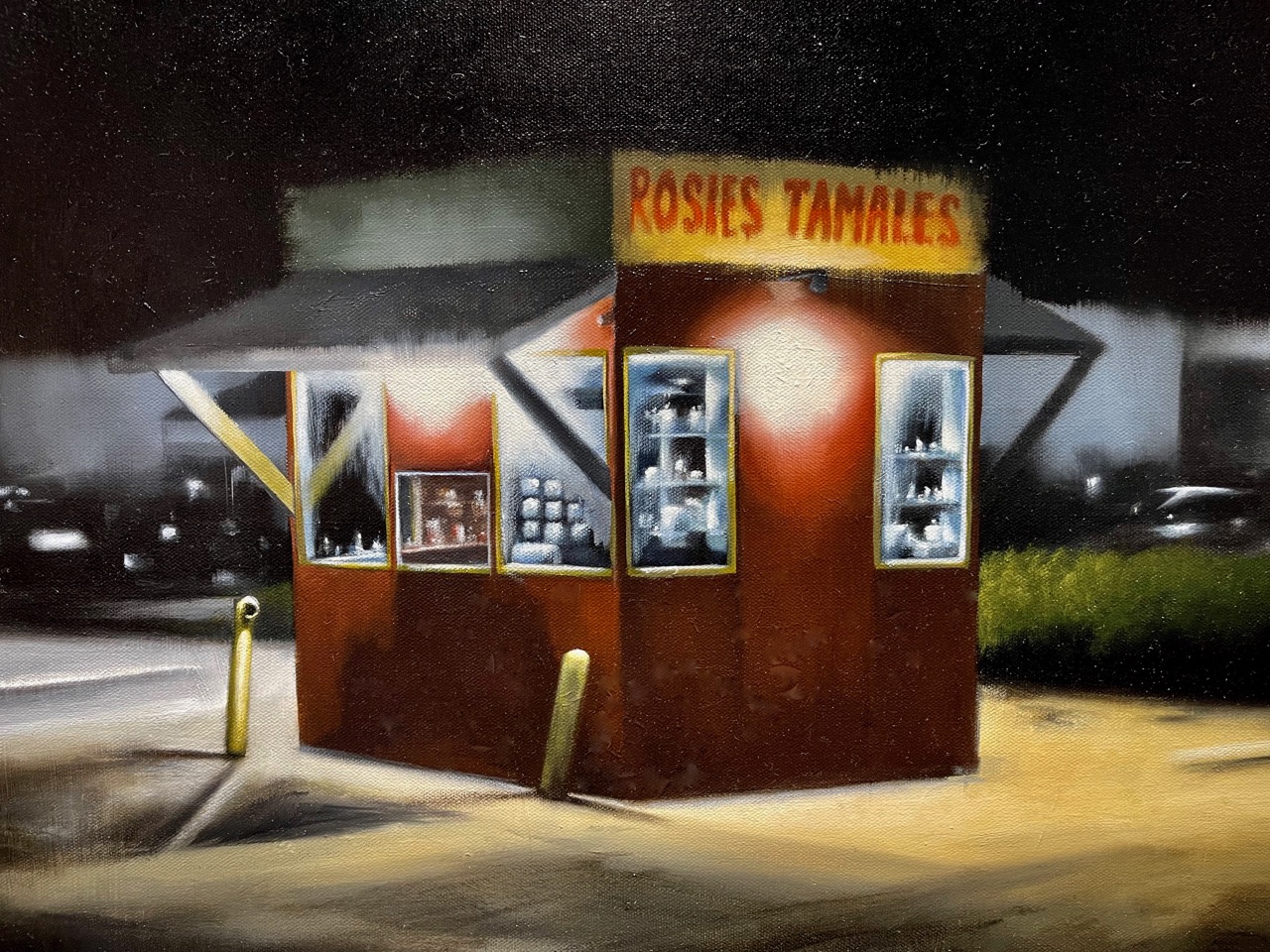
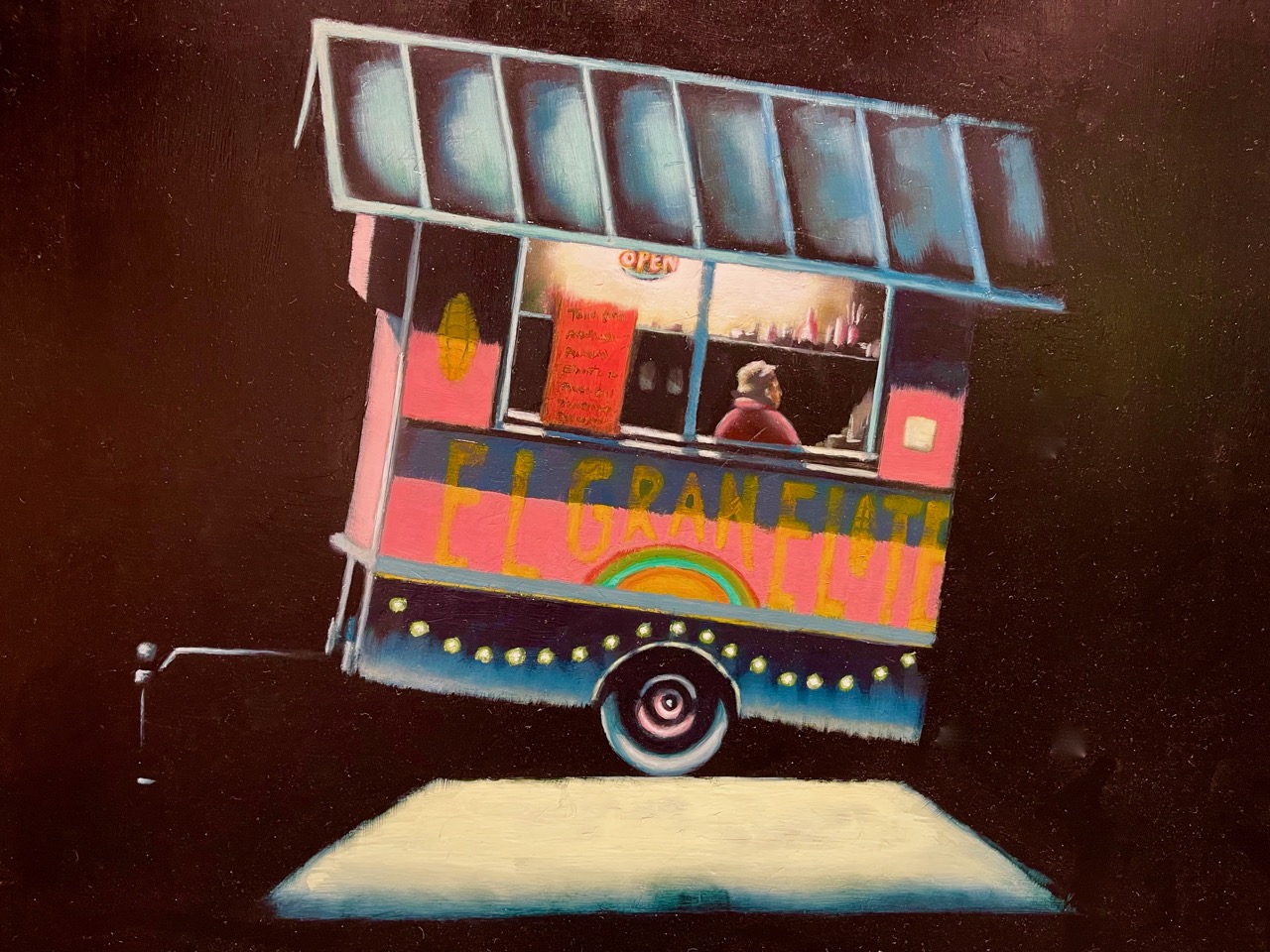
“Una Tarde en Meoqui”
by Wayne Alaniz Healy portrays a family around a table of food, and I
suspect some of those onlookers might become a meal sometime later.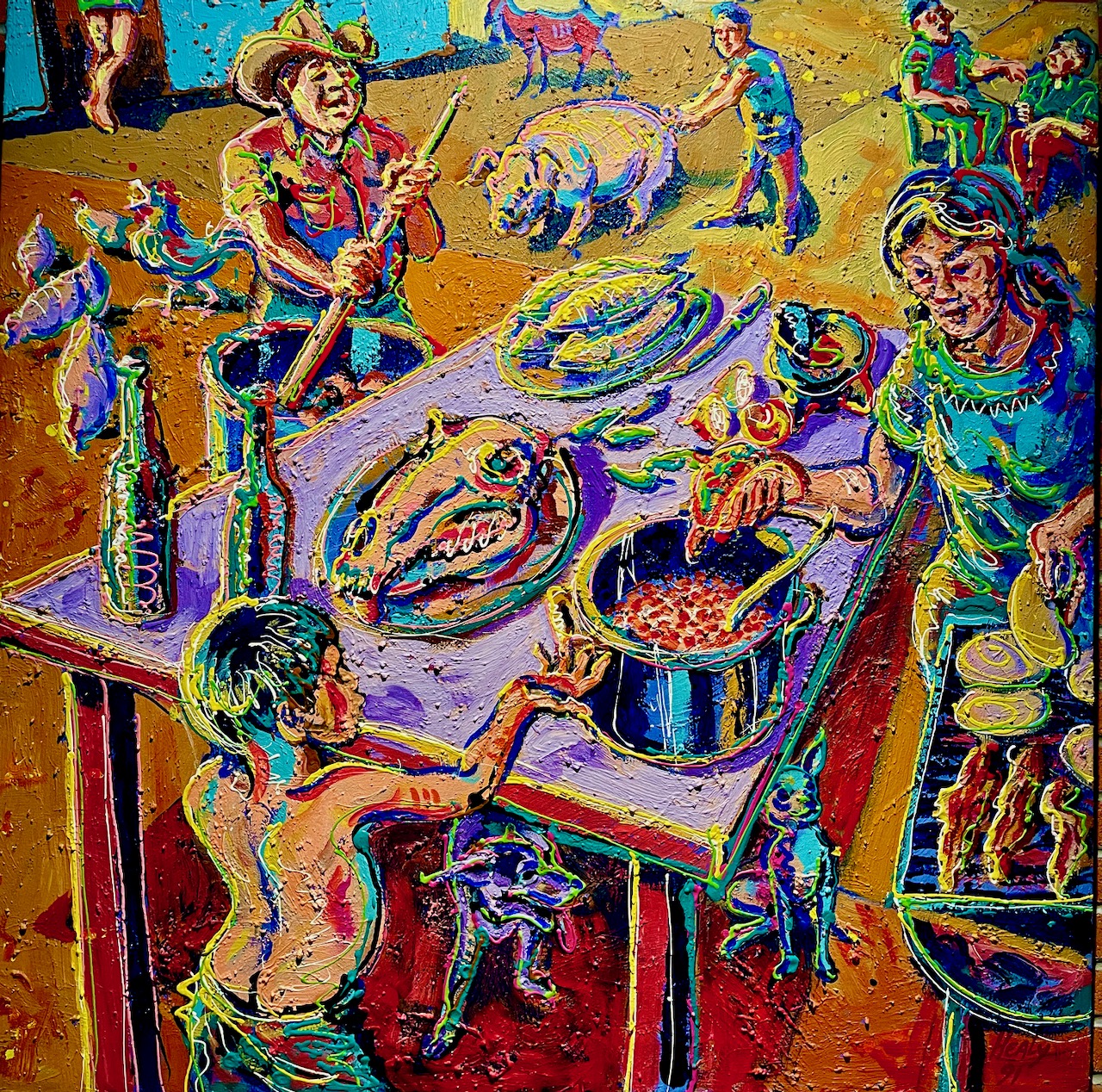
Healy’s “Beautiful Boyle Heights” has great perspective to it.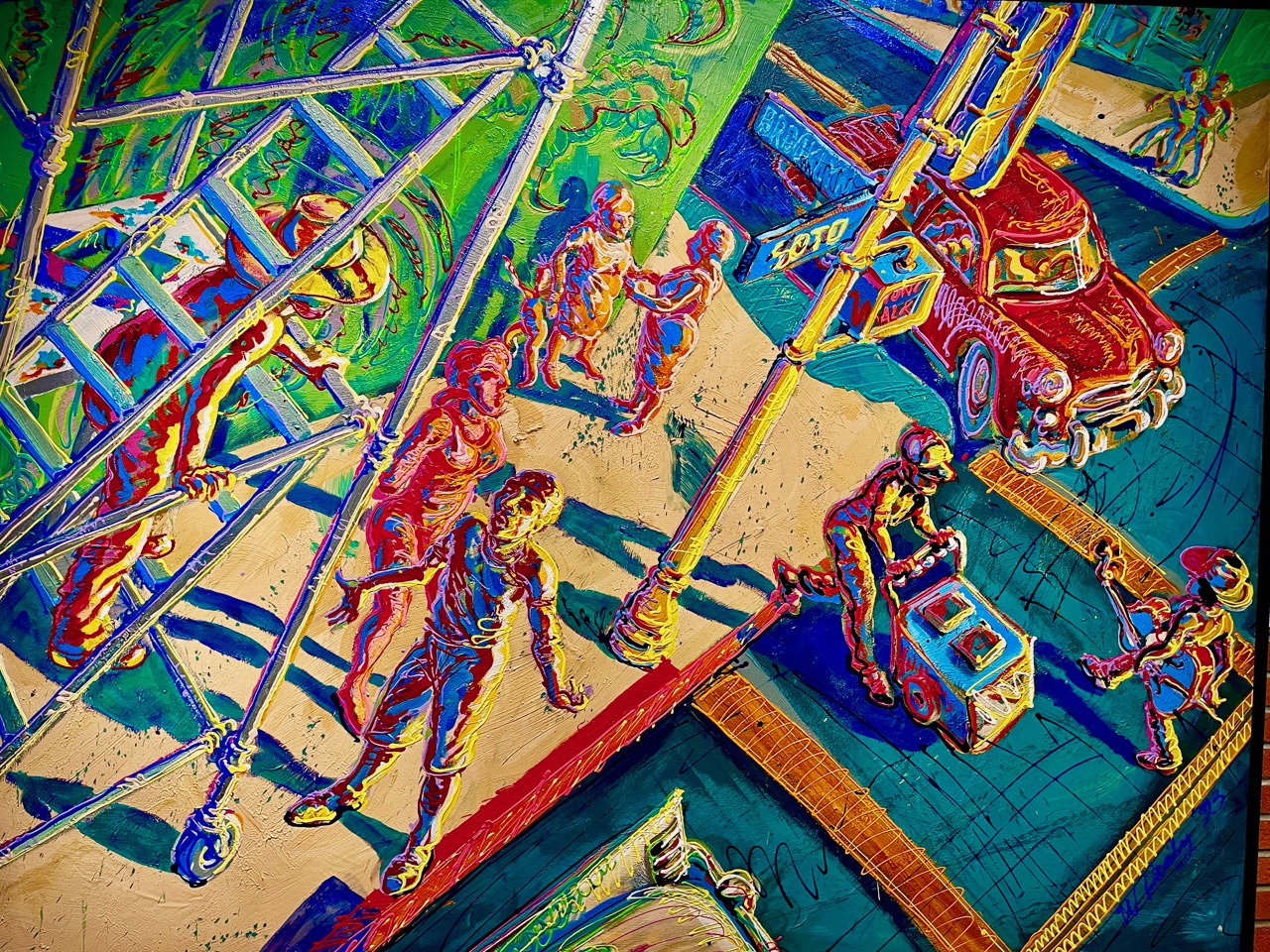
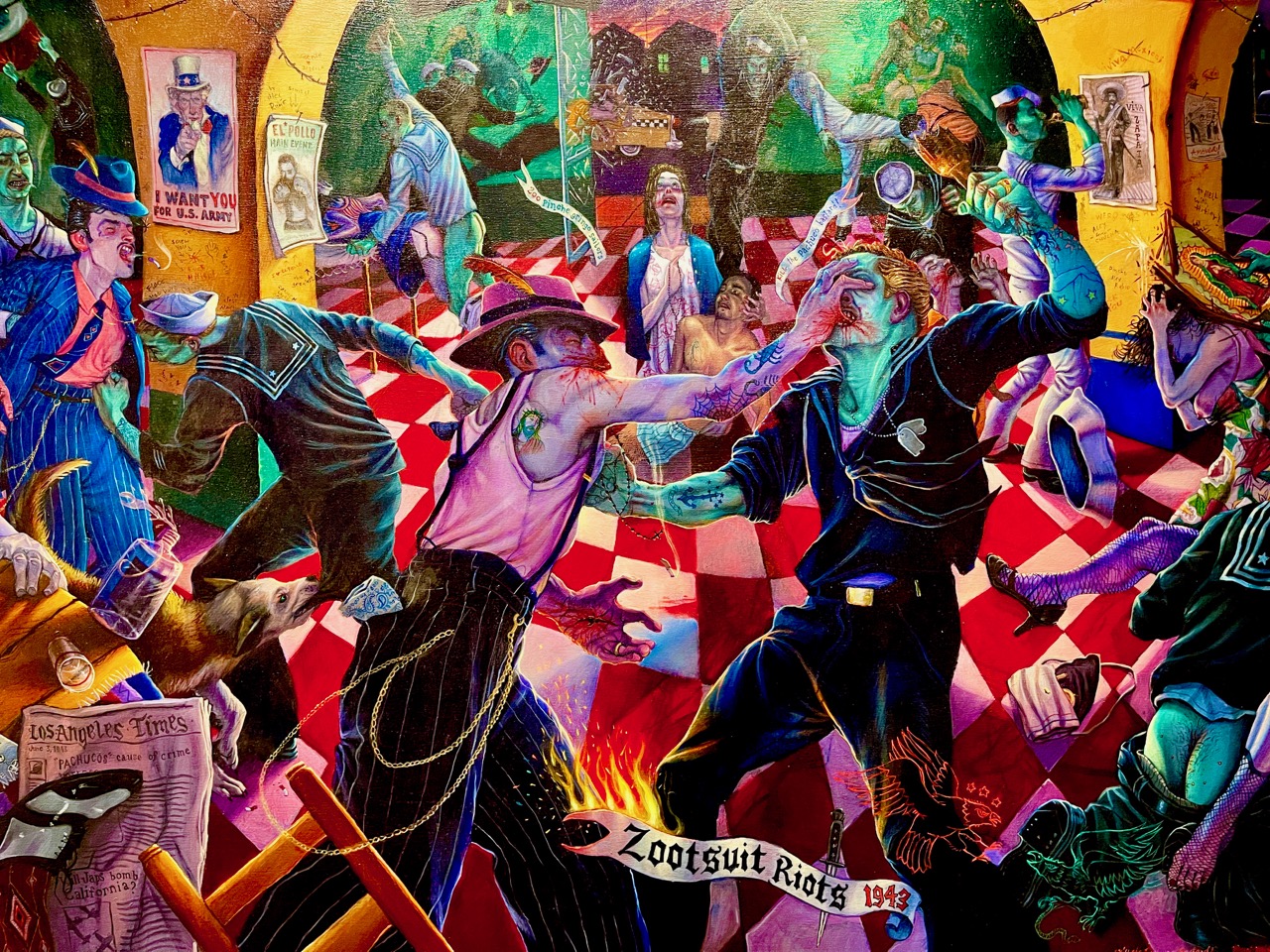
One painting seemed to jump off the wall with its intense colors and disturbing content. “Kill the Pachuco Bastard” by Vincent Valdez takes you back to the Zoot Suit Riots of 1943.
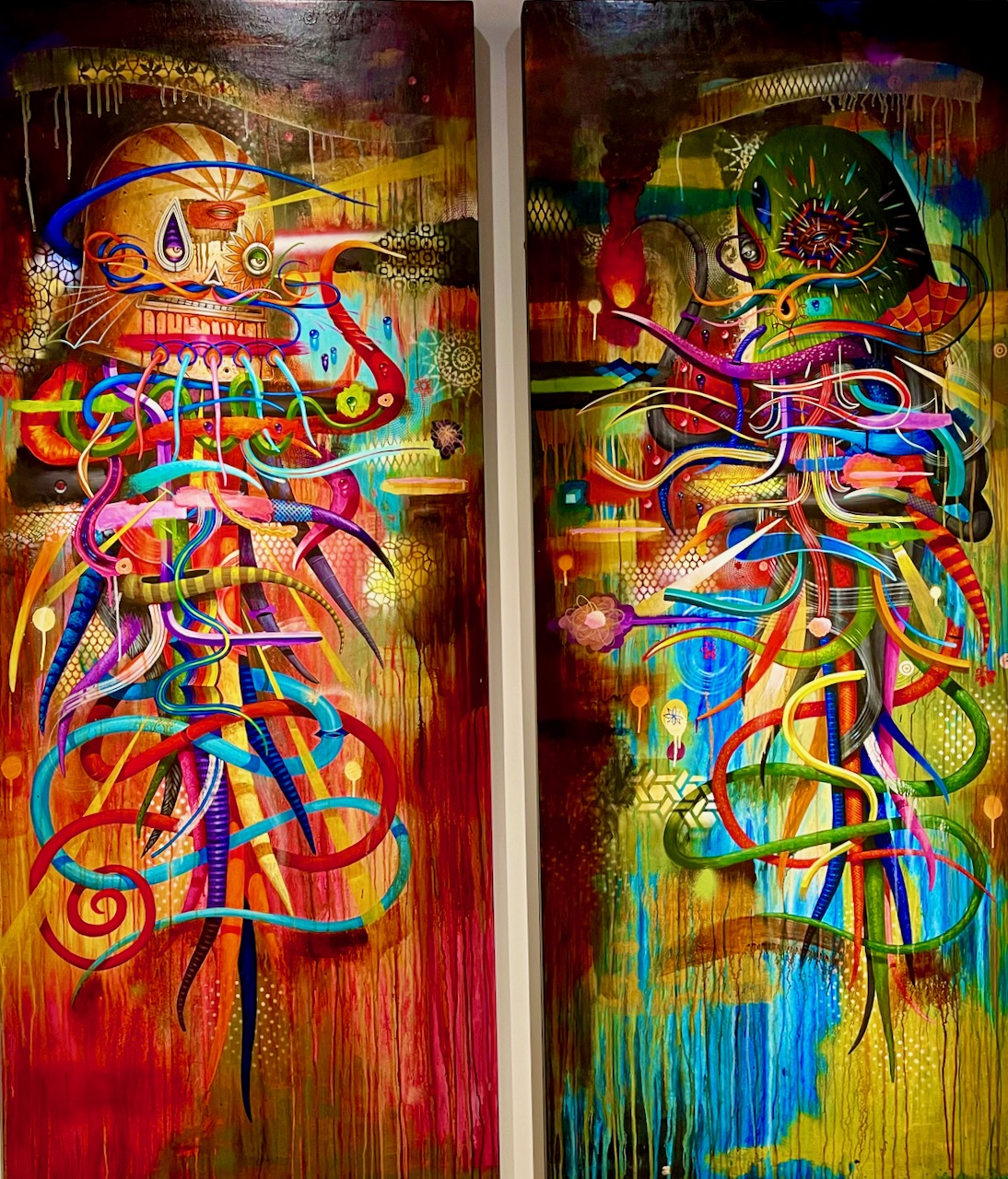
I found “La Batalla” by Jaime Zacarías very intriguing.
“It’s A Brown World After All” by Eloy Torrez featured Cheech himself. Fortunately, unlike Disneyland’s “It’s a Small World After All” ride, it was not accompanied by an annoying song, although had it played Born In East L.A., that would have brought back some fond musical memories.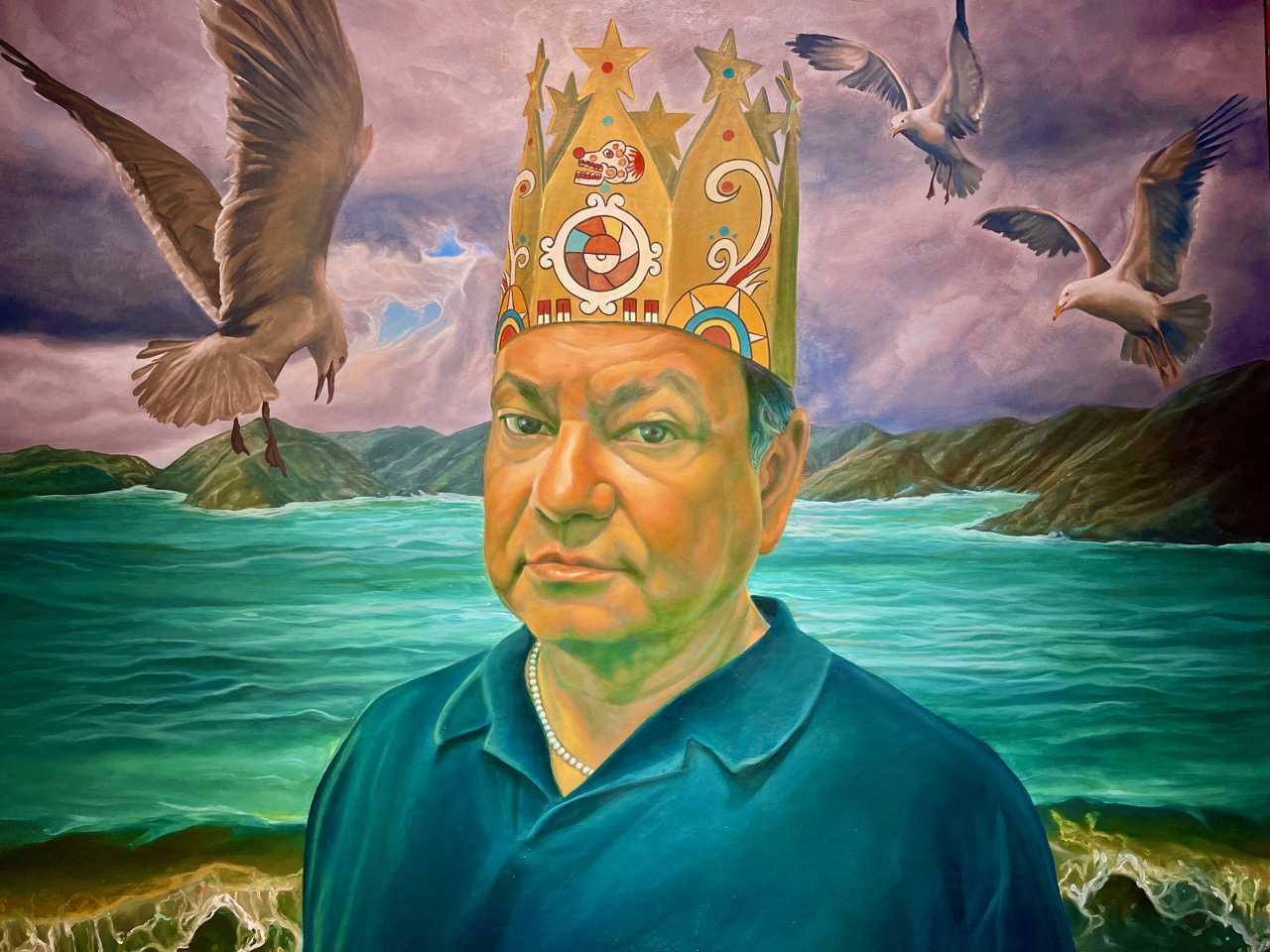
We were excited to see this portrait, because we’ll be visiting the Frida Kahlo Museum this spring when we visit Mexico City.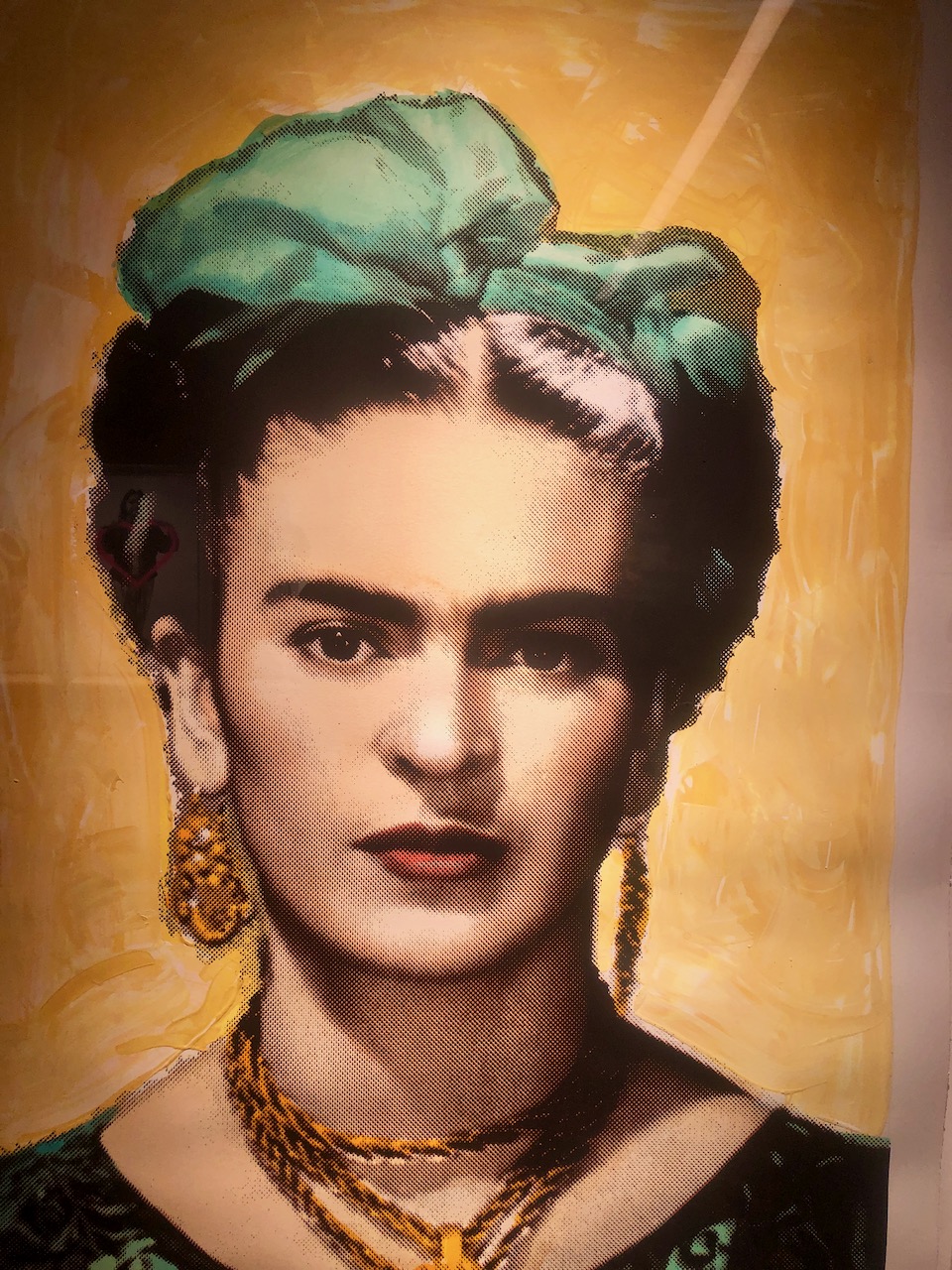
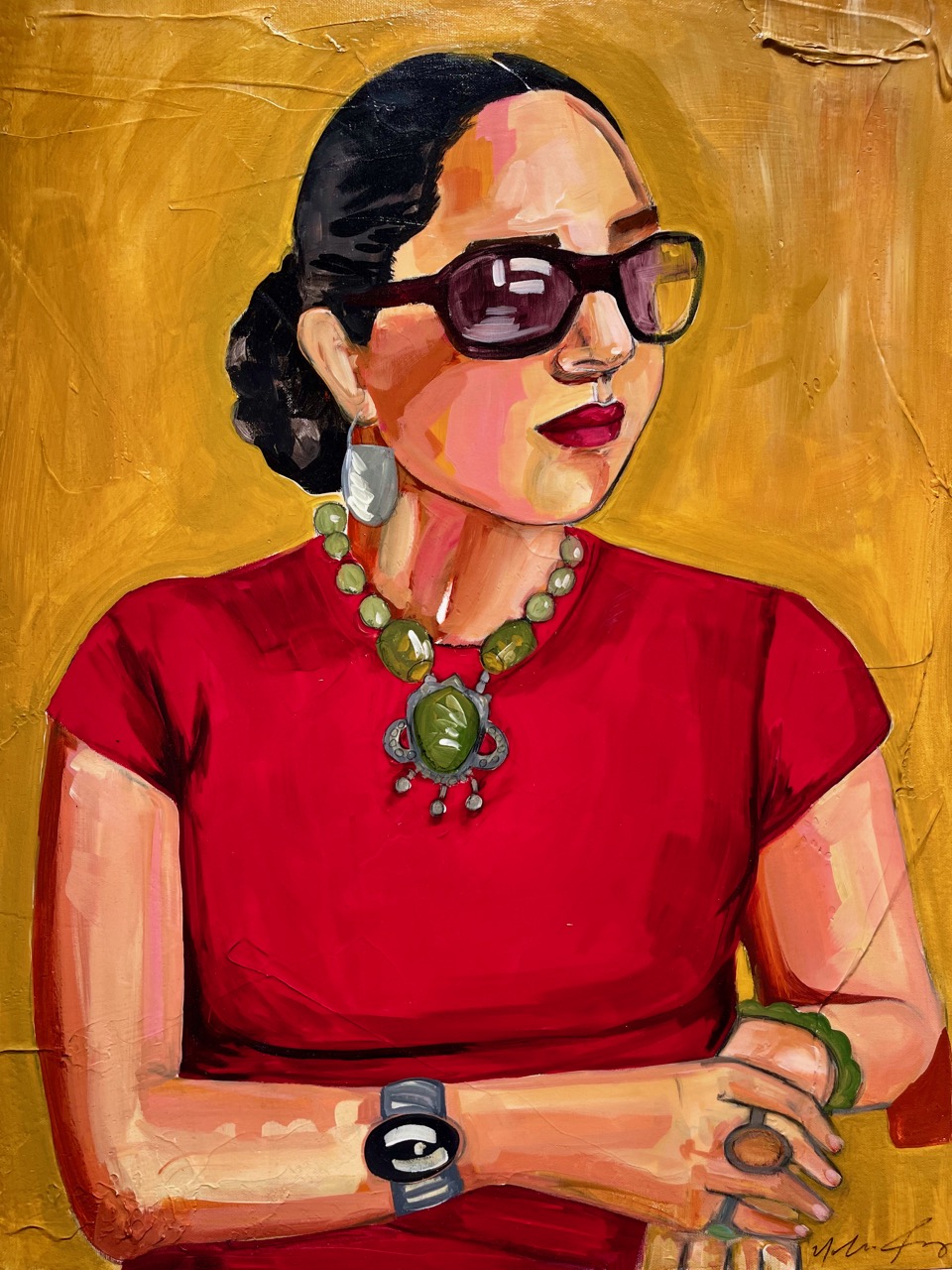
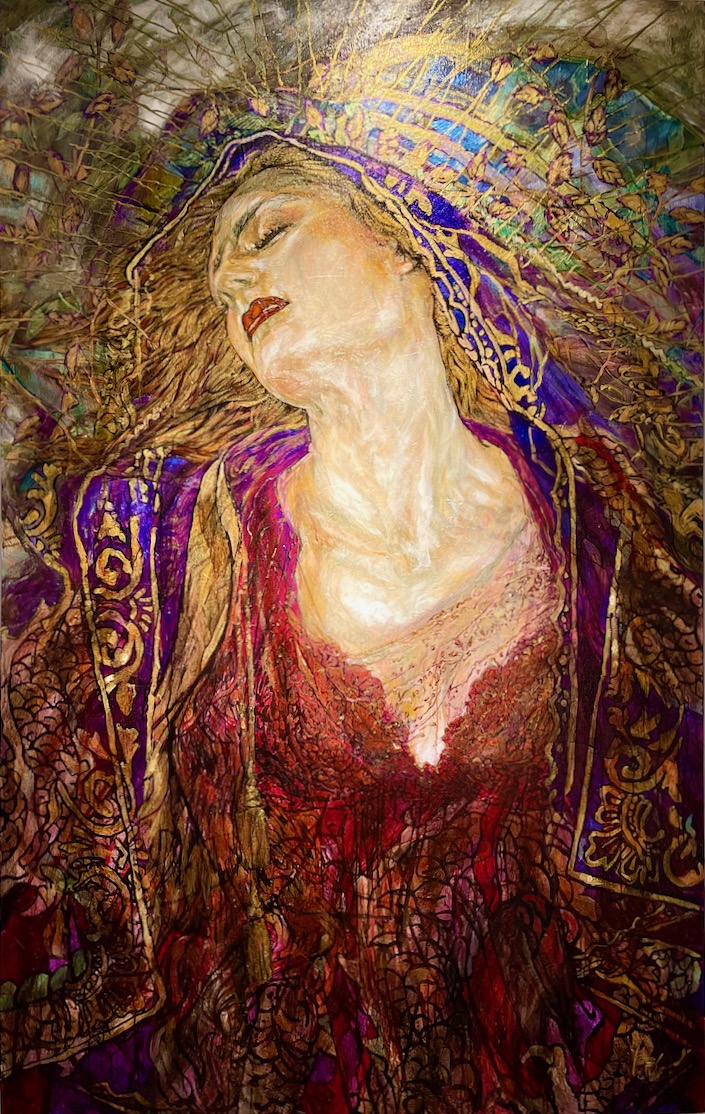
There were other stunning portraits, too. “Portrait of Diana With Sunglasses” by Yolanda Gonzáles on the left and George Yepes’ “Axis Bold As Love” on the right.
“Room on the Verge,” by Pattsi Valdez featured some dancing brooms. Perhaps that’s why I was getting so swept away in this fabulous museum.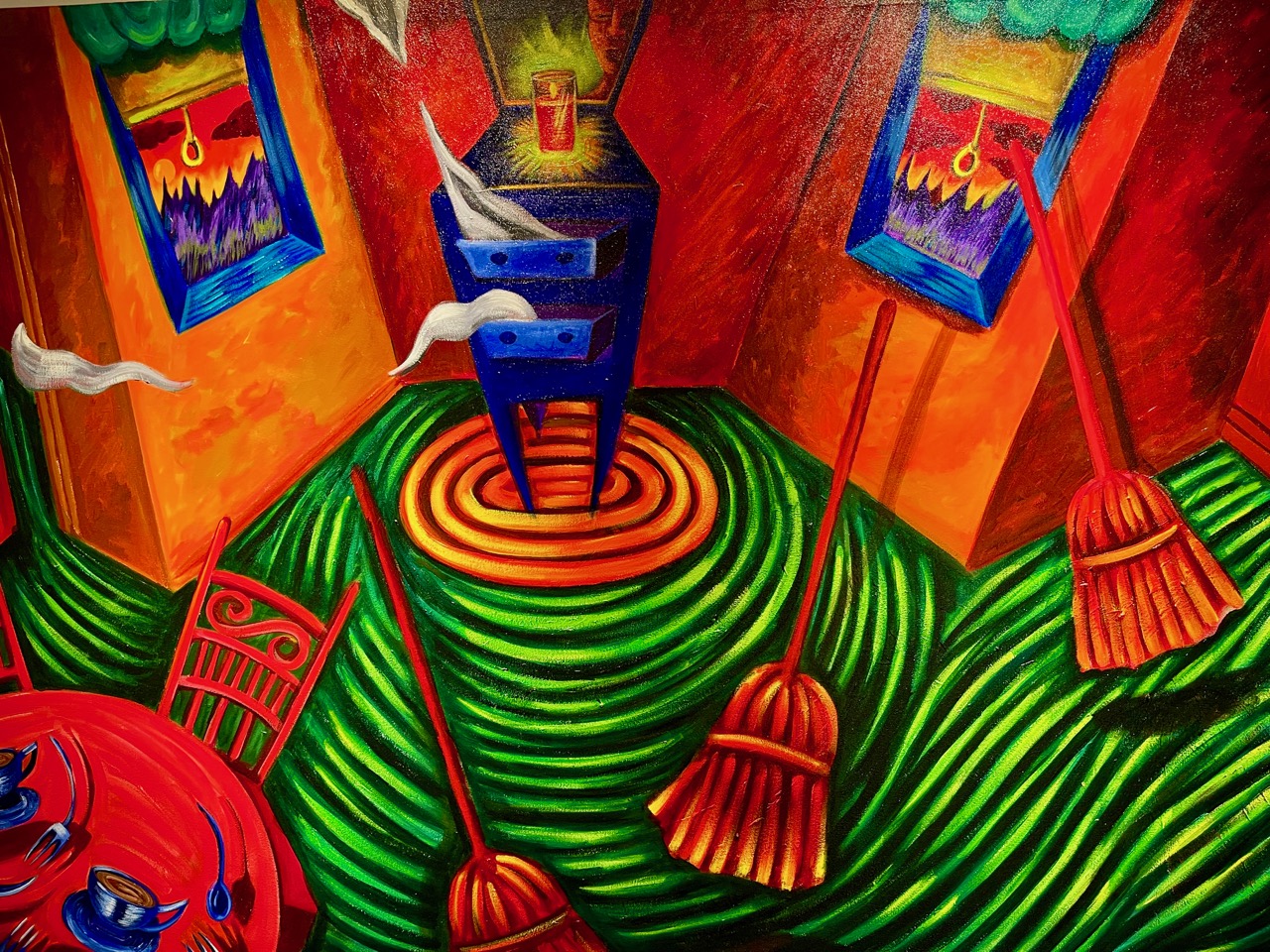
If you ever wondered what the entrance to hell looks like, “The Welcoming Committee”
is your answer, at least according to artist Alfredo de Batuc. The
picture has a much deeper meaning, which is just another reason to visit
The Cheech. You learn a lot here.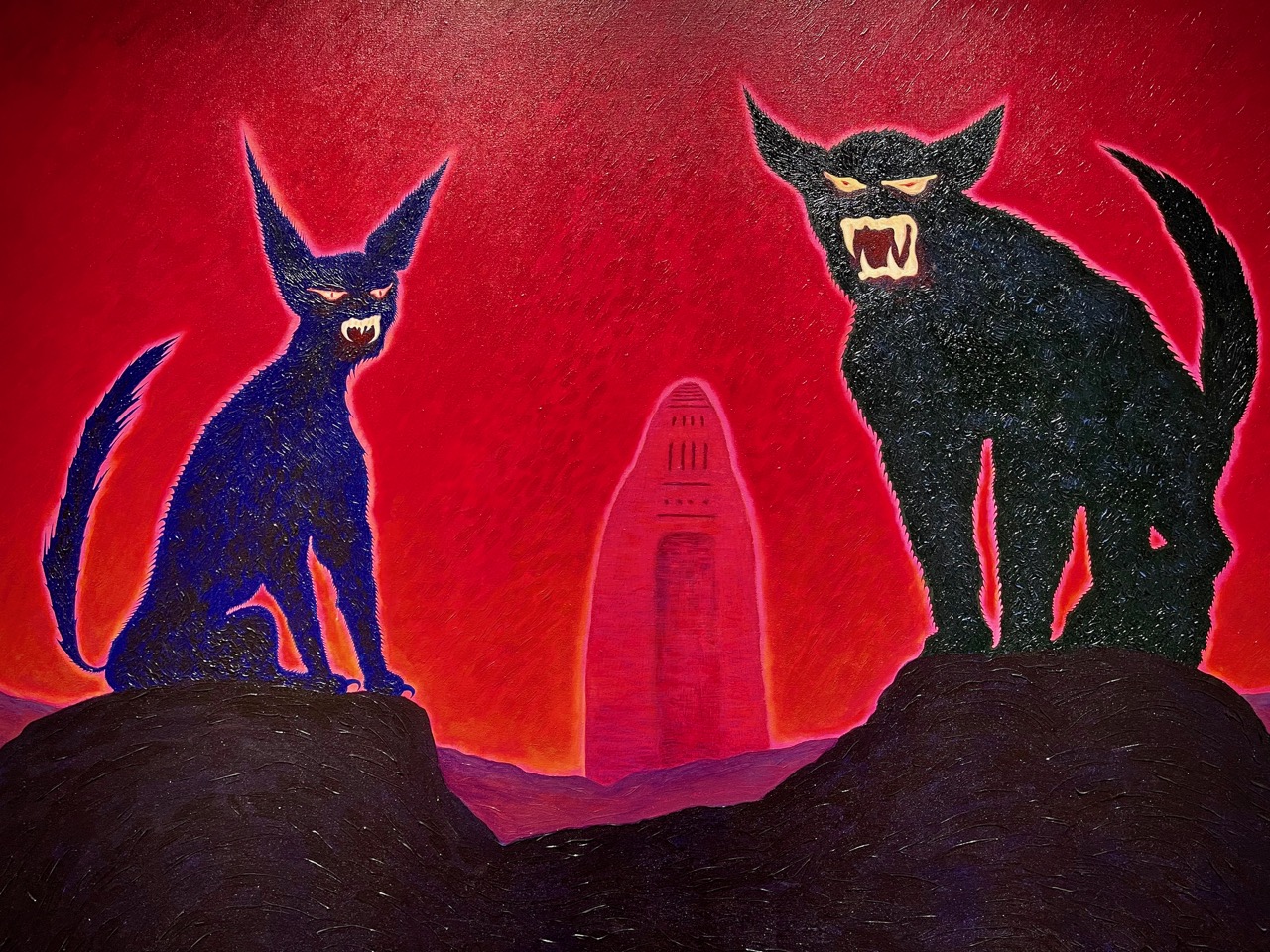
“Convertible Operas/Cinema Deudeuche,” by John Valdez conveys the theme of L.A. road rage and the L.A. beach convertible.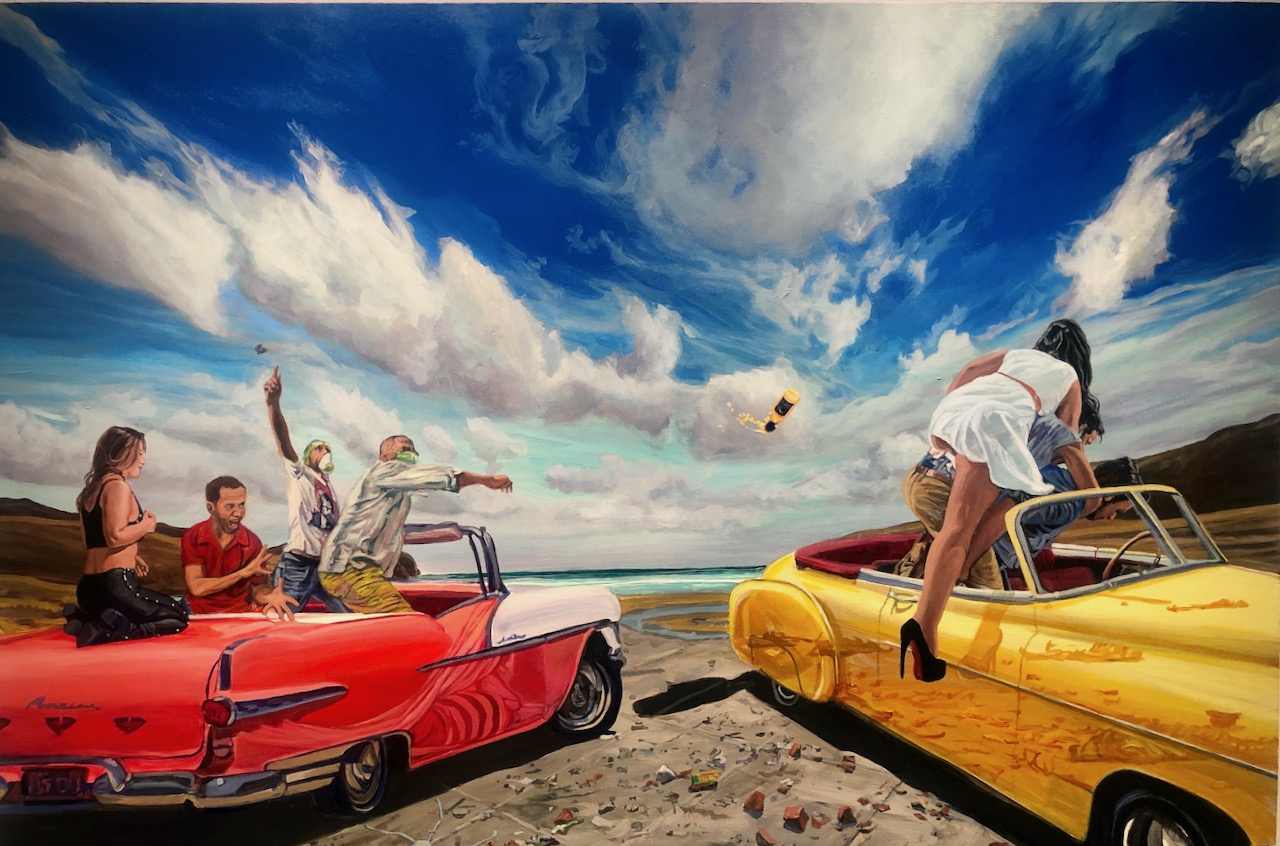
A couple of paintings by Leo Limón, “Los Muertos” on the left and “Un Poquito Sol,” were impactful By now, I was wishing this art gallery would keep on going forever, and that is something I had seldom wished at an art museum before.
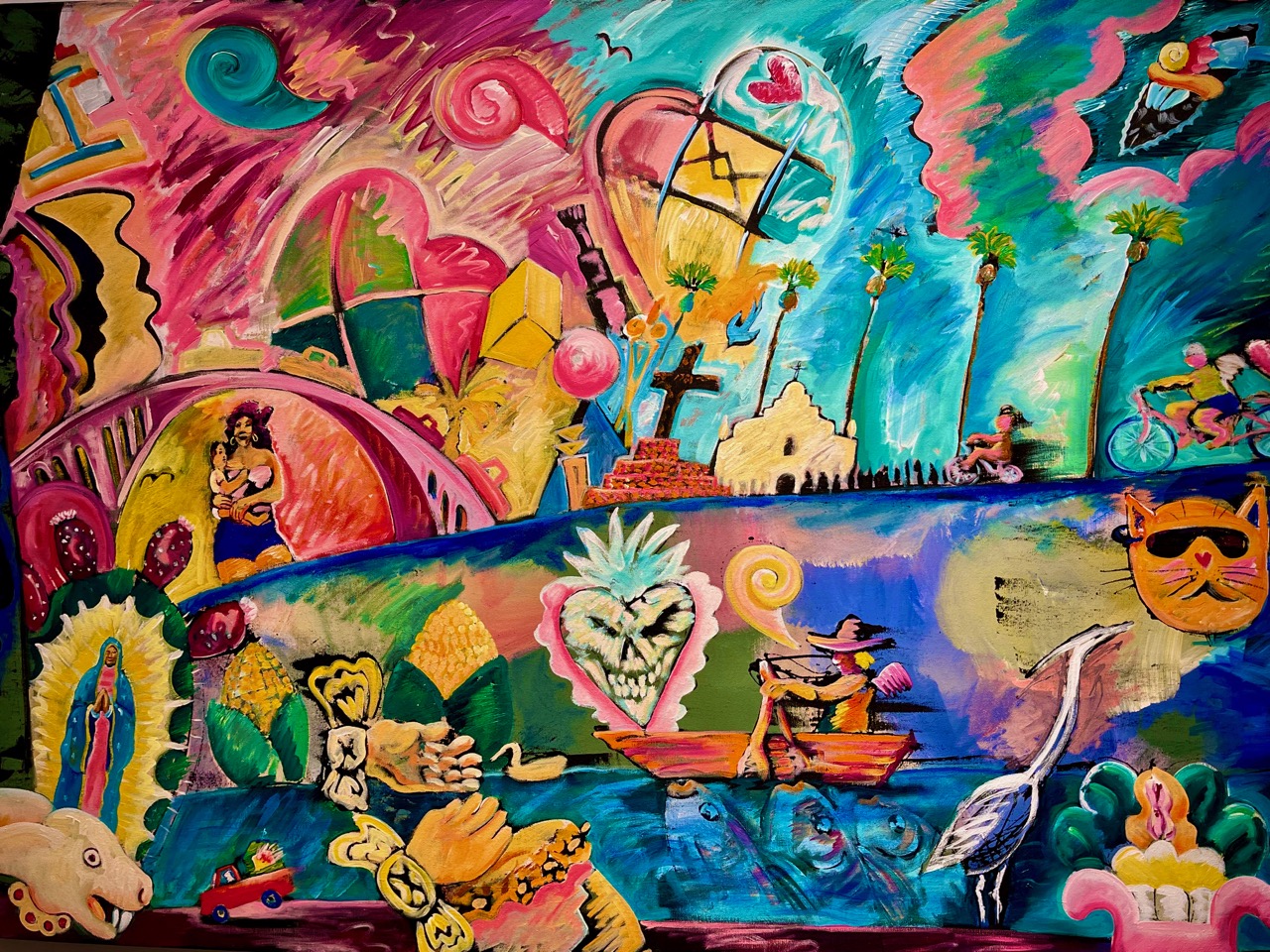
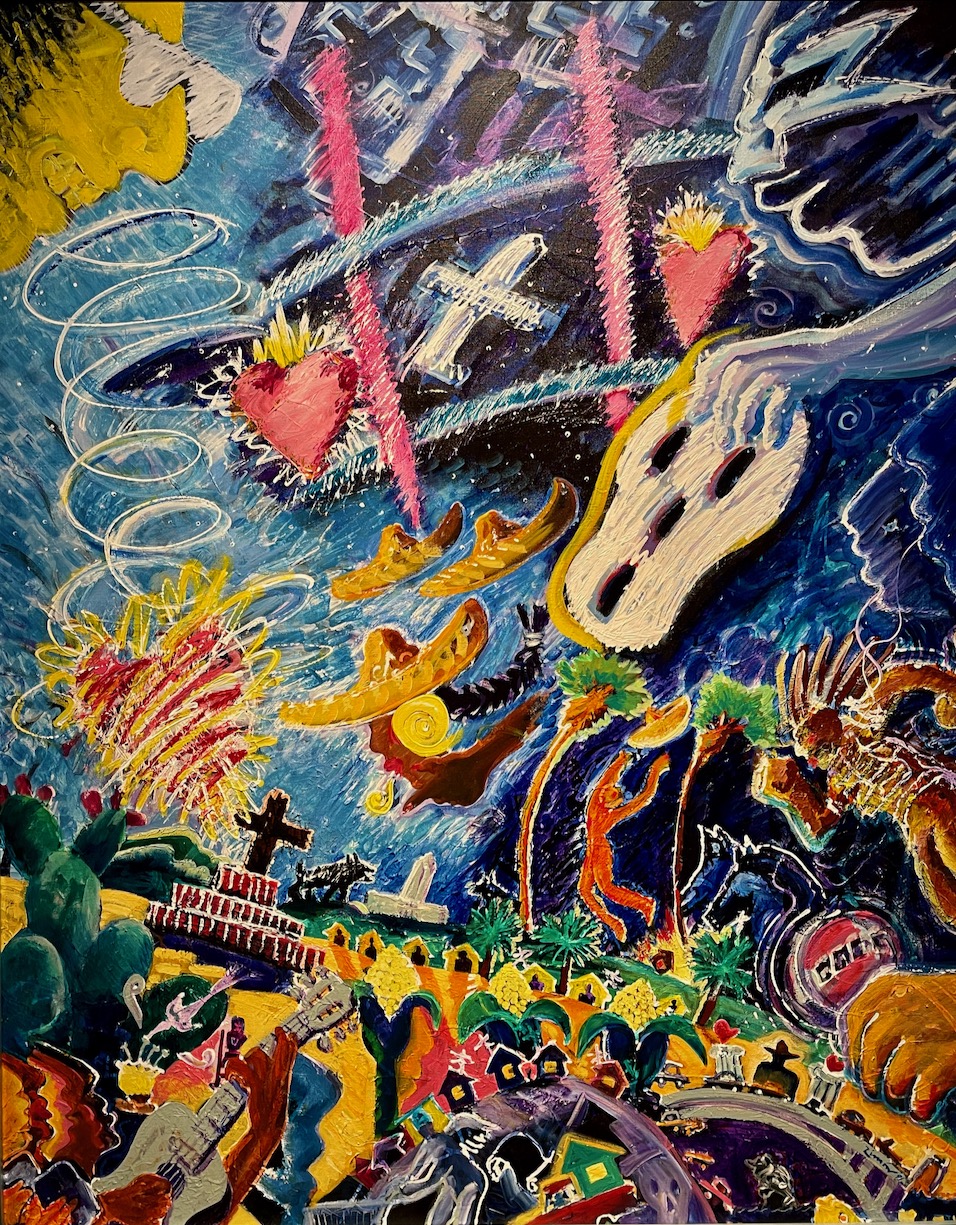
All the while, we were reminded to support local artists.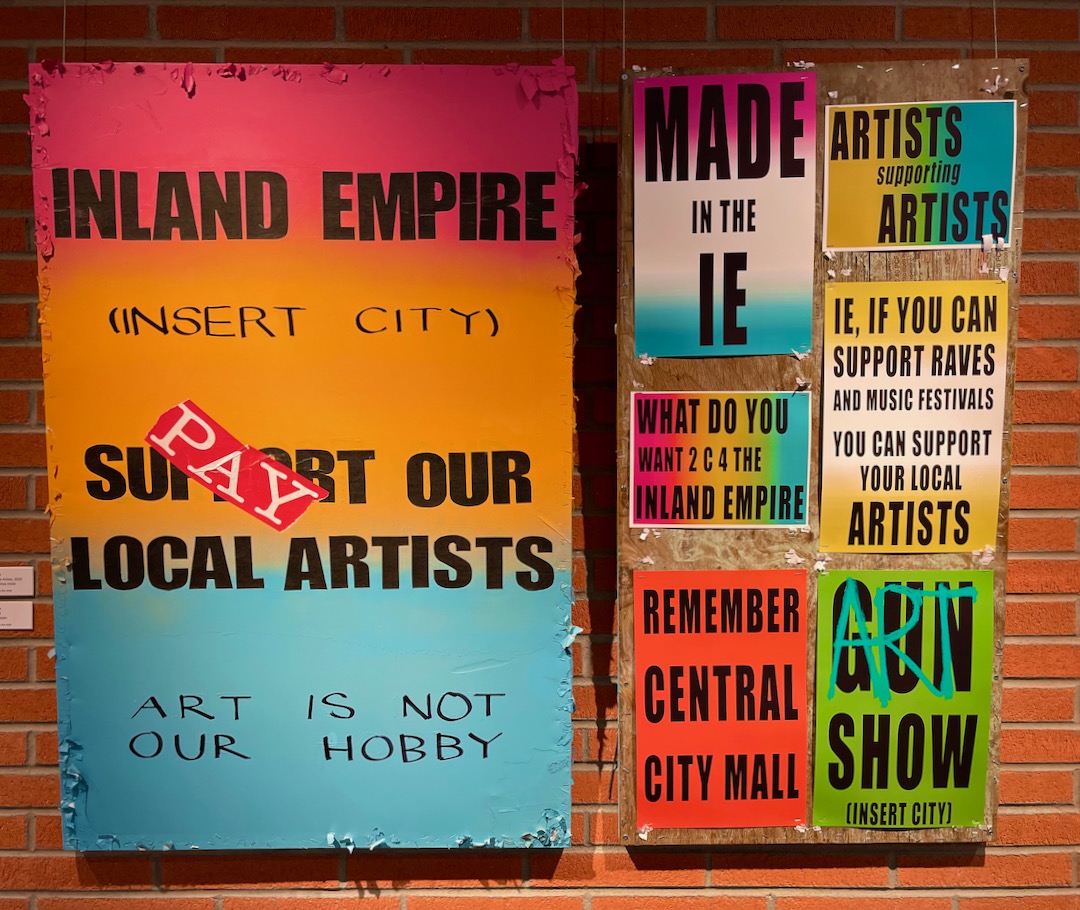
I
could on and on about Marin’s collection, but you have to come to the
museum to see them yourself. From serious to playful, they all dazzle
with color in a wide range of styles and techniques. Before
checking out the special exhibition upstairs we stopped to admire the
Donor Heart Sculpture, created by the de la Torre brothers, whose work
we’d see next.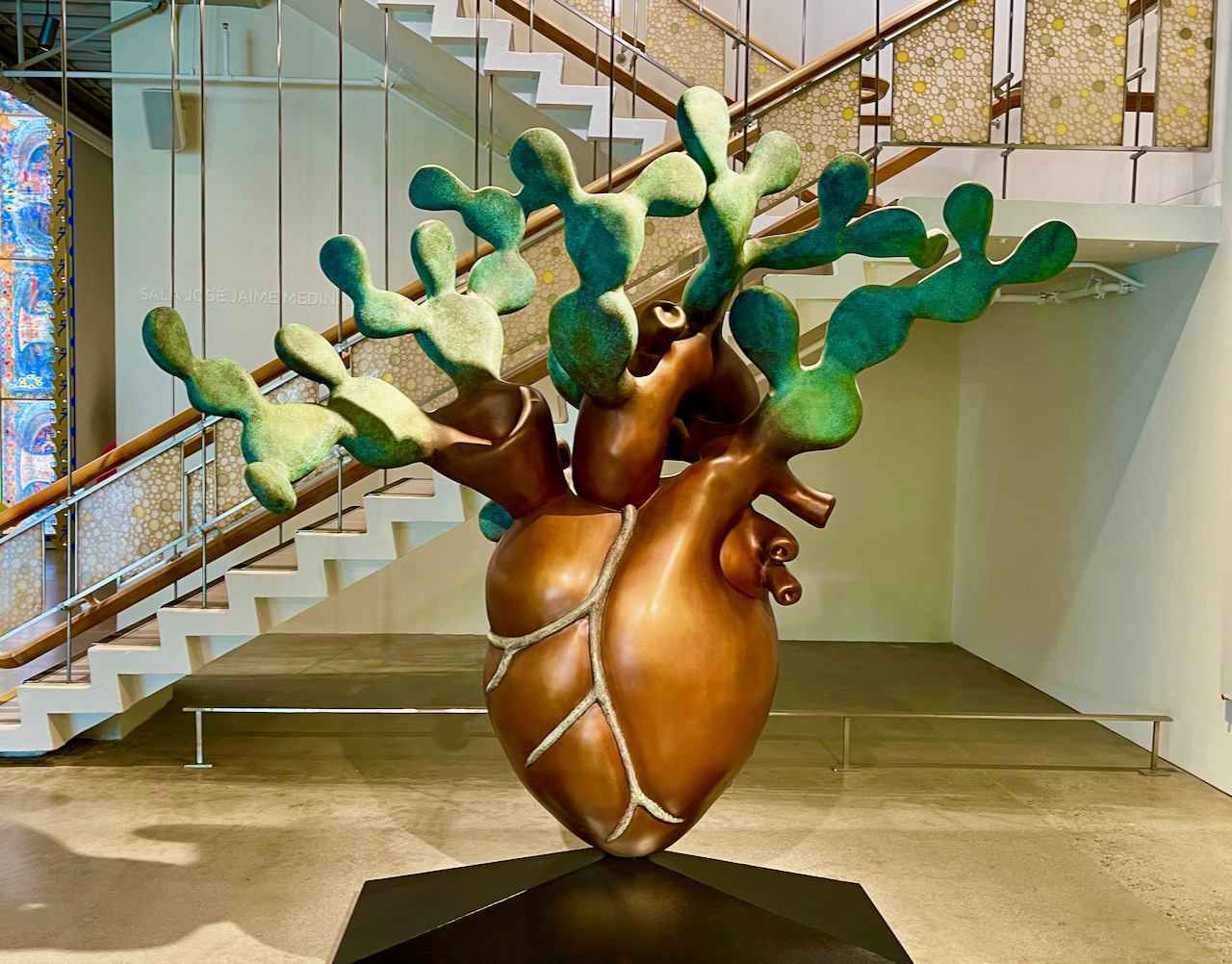
We headed upstairs to the special exhibit, and it was wild. We were met by a blaze of color and unusual sound. The “Collidoscope: de la Torre Brothers Retro-Perspective” is like nothing we have experienced before. The de la Torre brothers grew up in Guadalajara and “their work draws from traditional Mexican folk art, pop culture, and religious imagery and mythology.”
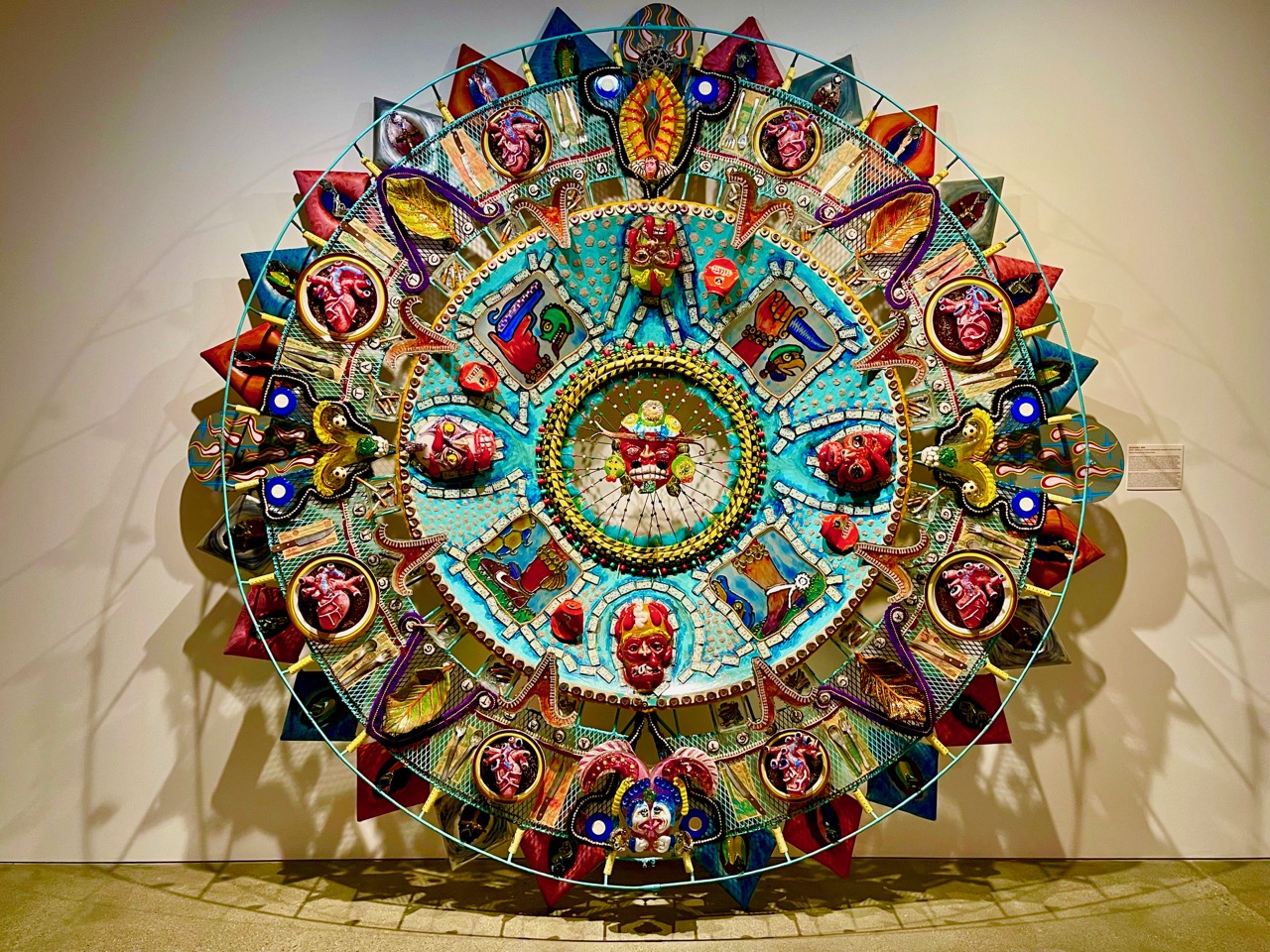
This
very cool piece turned round and round, and its mesmerizing colors made
it hard to turn away. This piece intrigued me more than many since I
attended San Diego State (aka the “Harvard of the West”). According to what I read at kcet.org, “La
Belle Epoch depicts the heyday of the Aztecs as its timepiece. There
are hearts going around the Ferris wheel, which have all been
extricated. Surrounding them are clues to their demise.” I always knew San Diego State was a school with a heart.
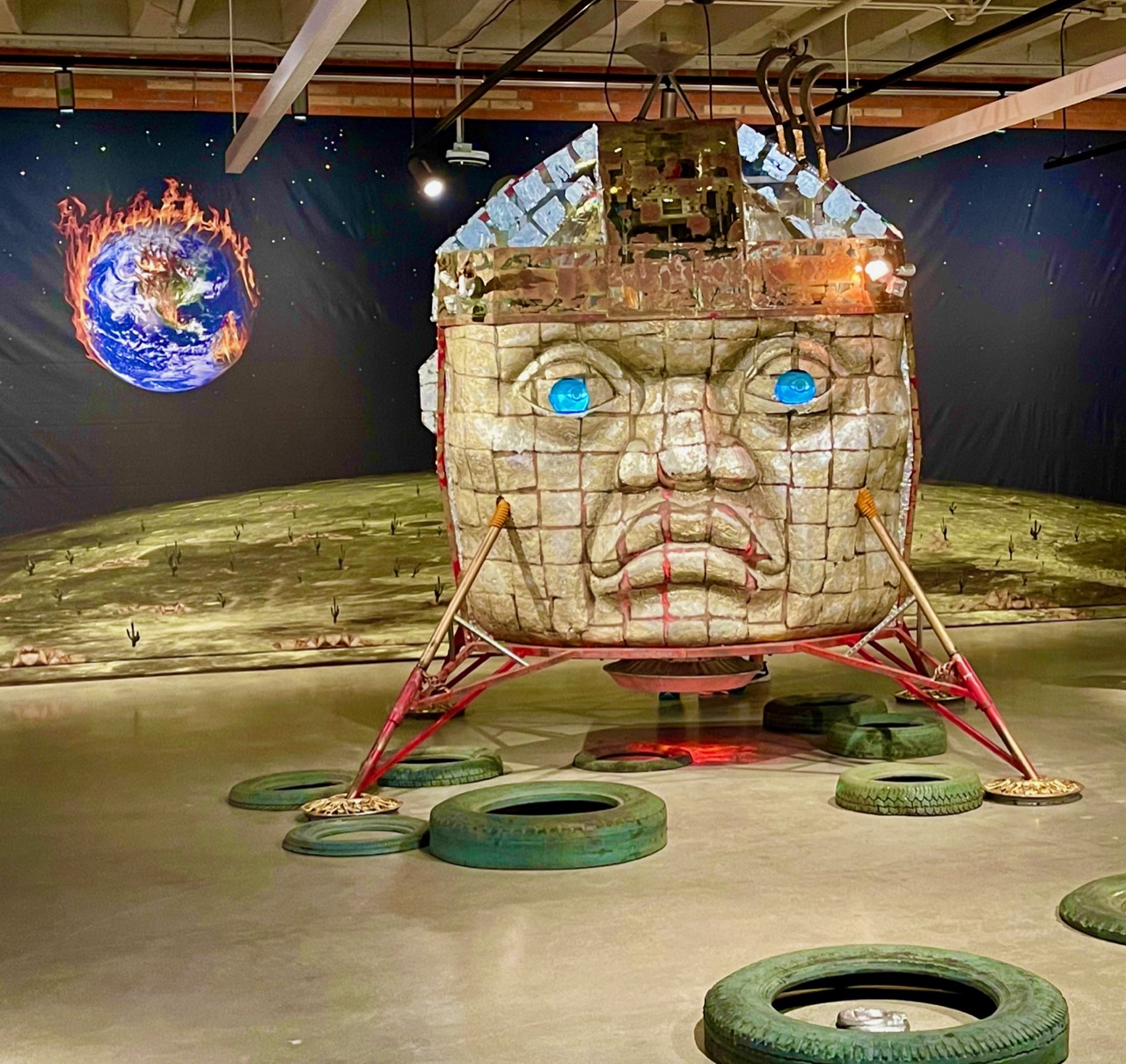
I don’t believe NASA ever built an Olmec head lunar landing vehicle, but if it had, more people would be interested in space exploration.
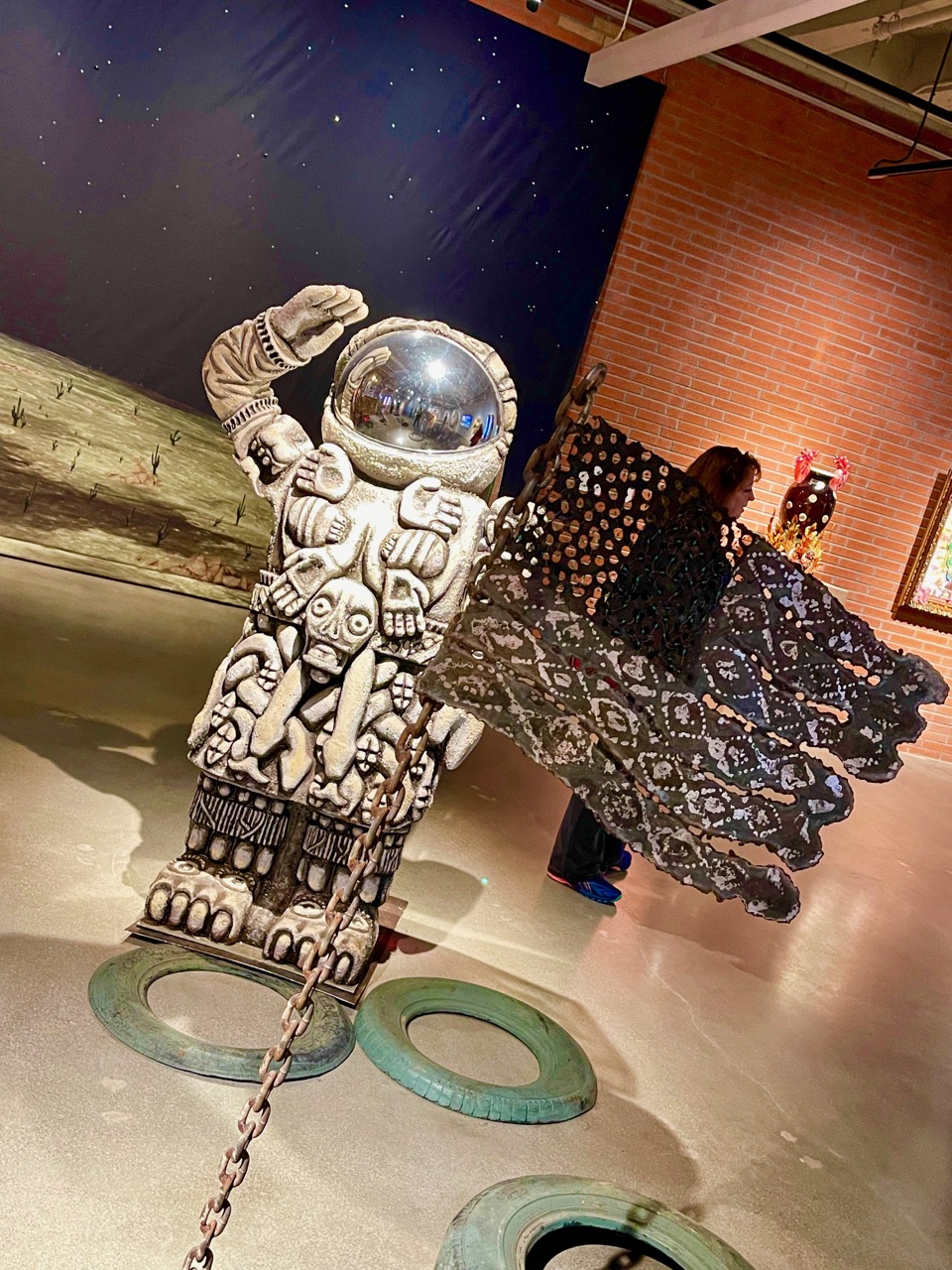
This piece was entitled “Darwin’s Secret.”
The mixed-media installations that also incorporated a video were fascinating. Be on the lookout for the upcoming de la Torre brothers tour.
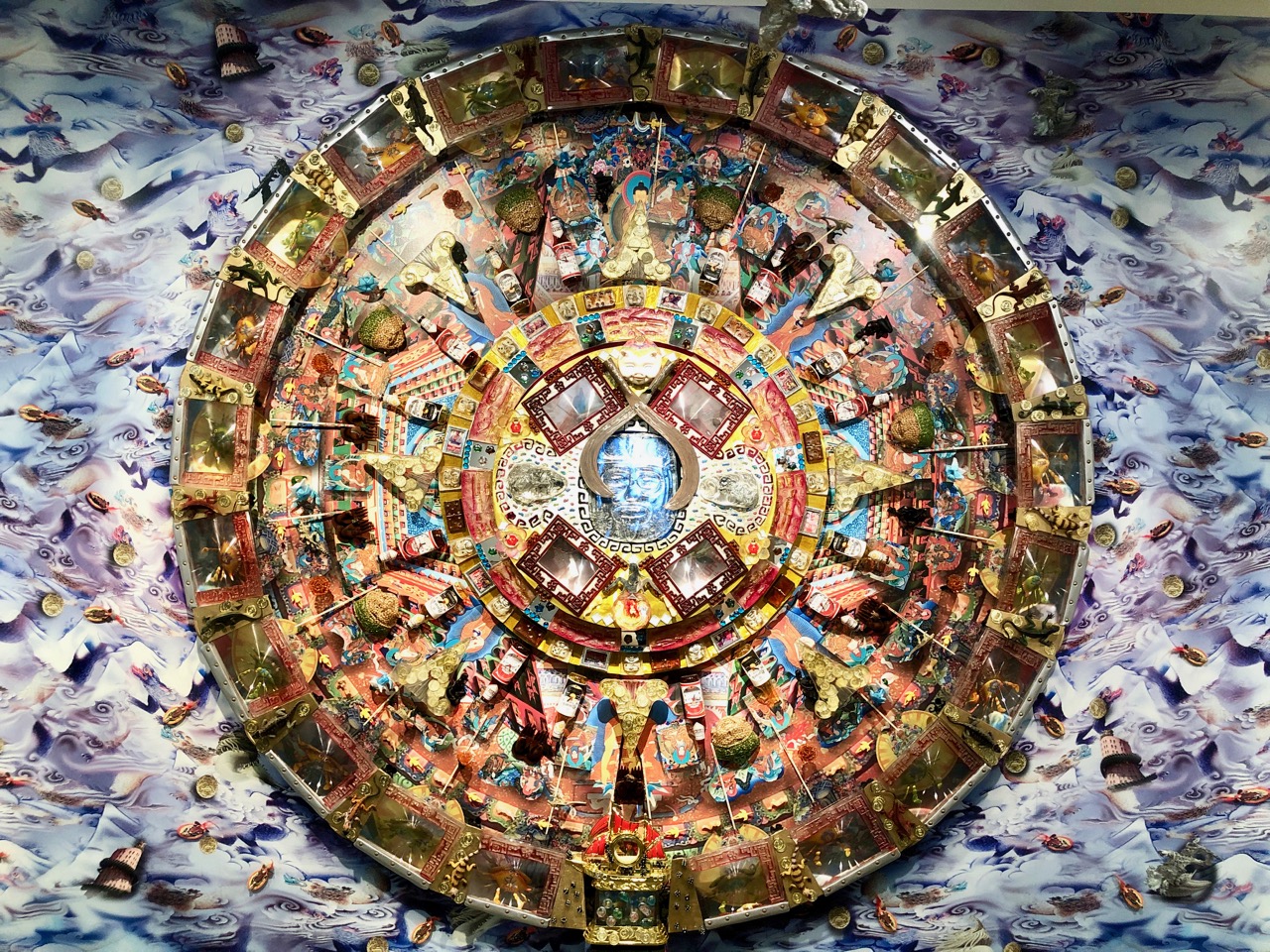
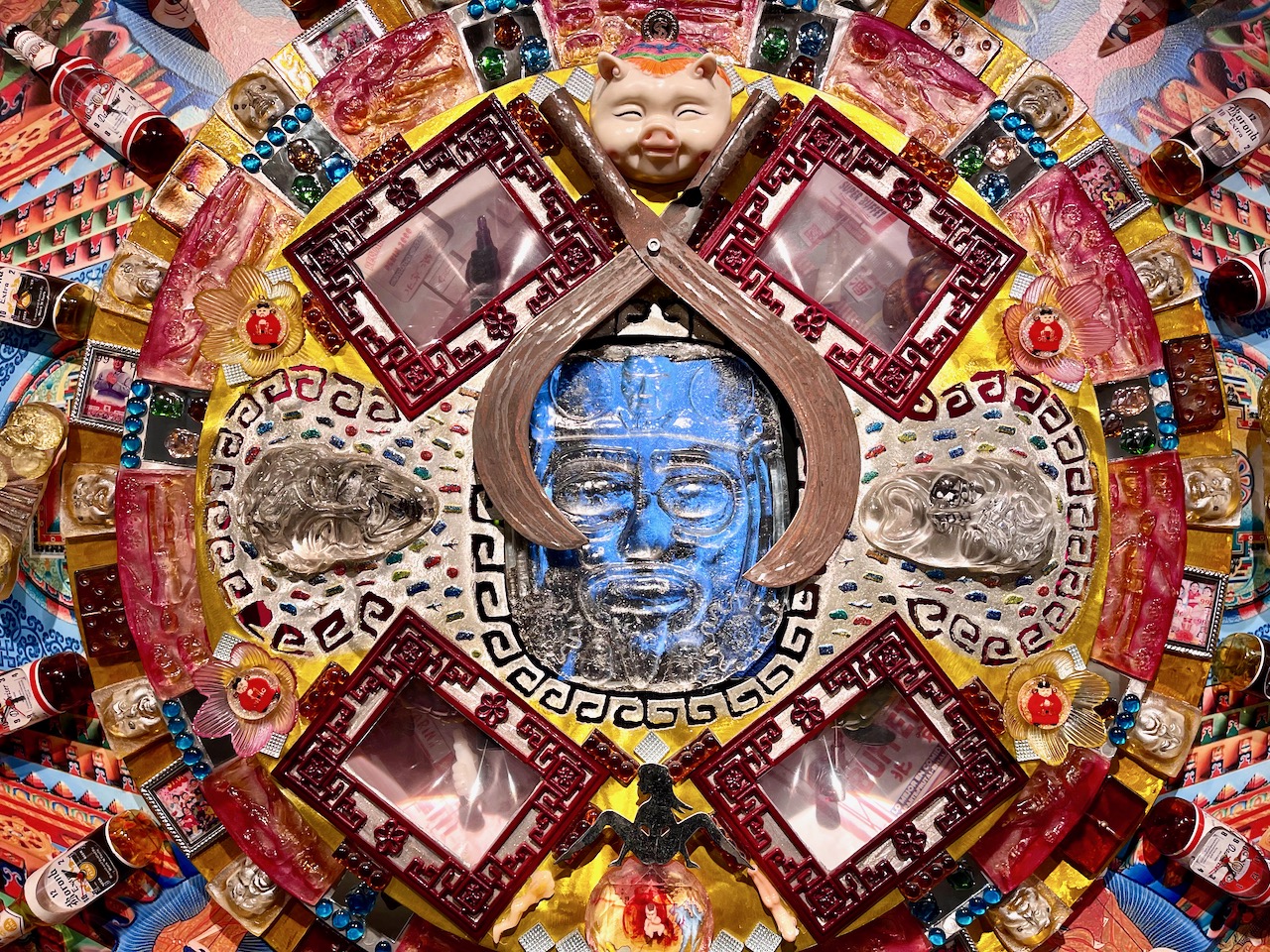
I recognized this “Invasive Species,” because we had so many of them in our college apartment.
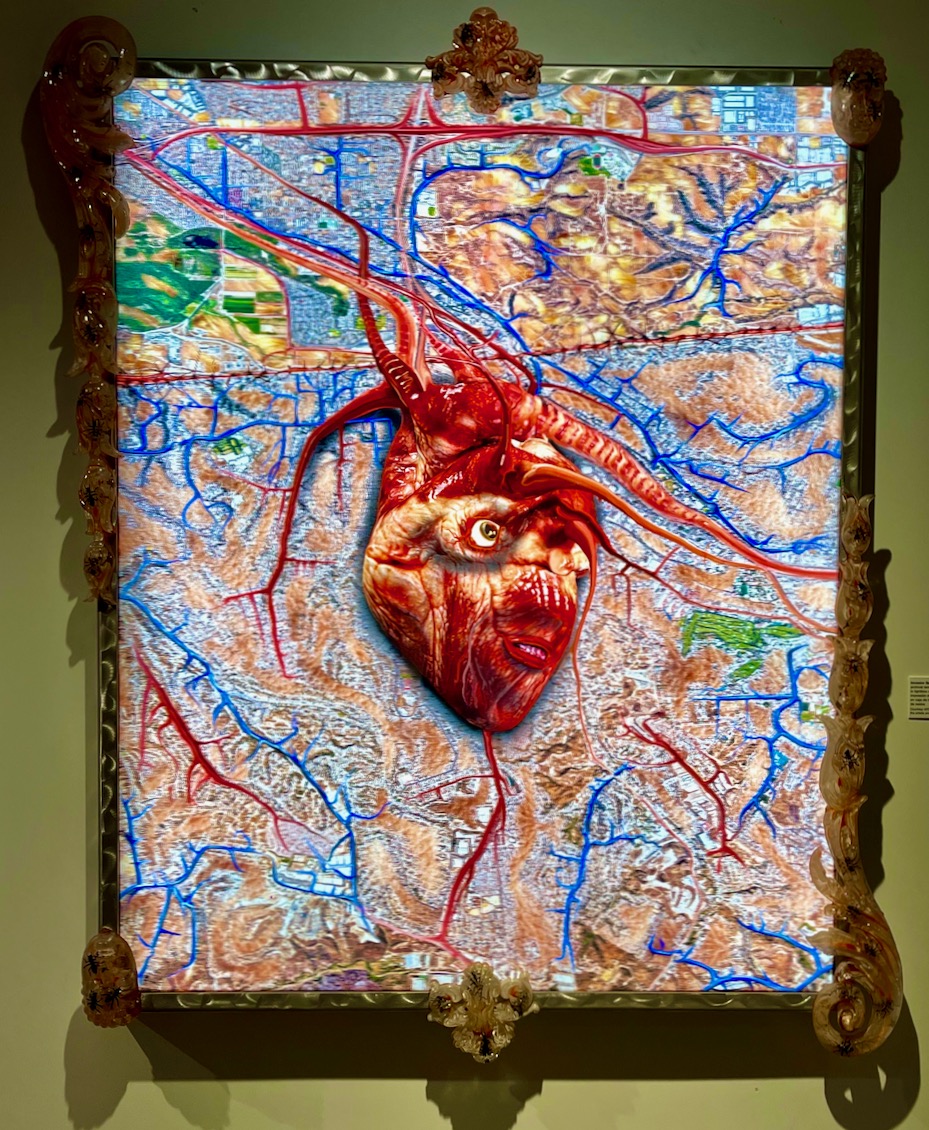
There are also many evocative blown-glass sculptures.
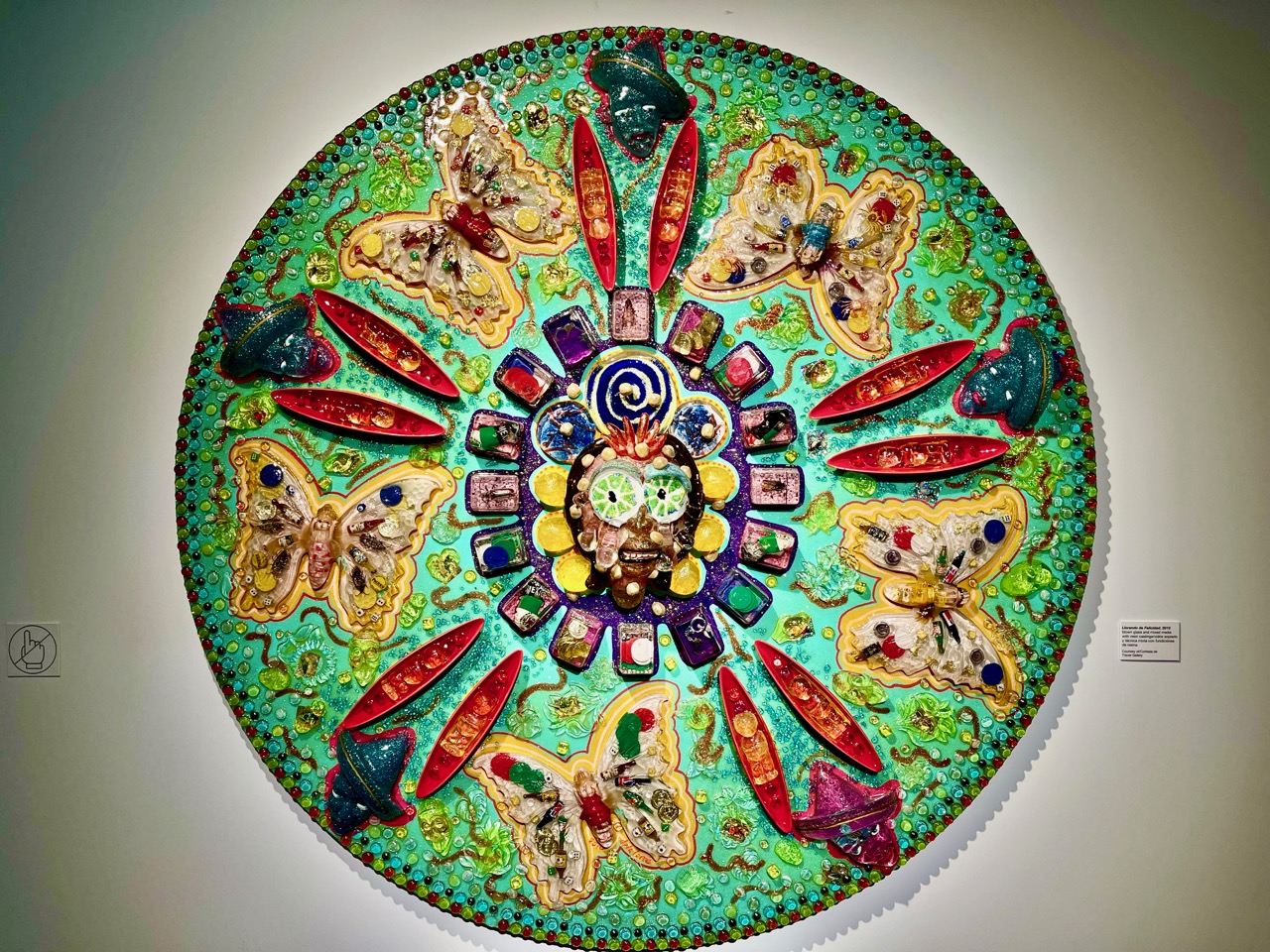
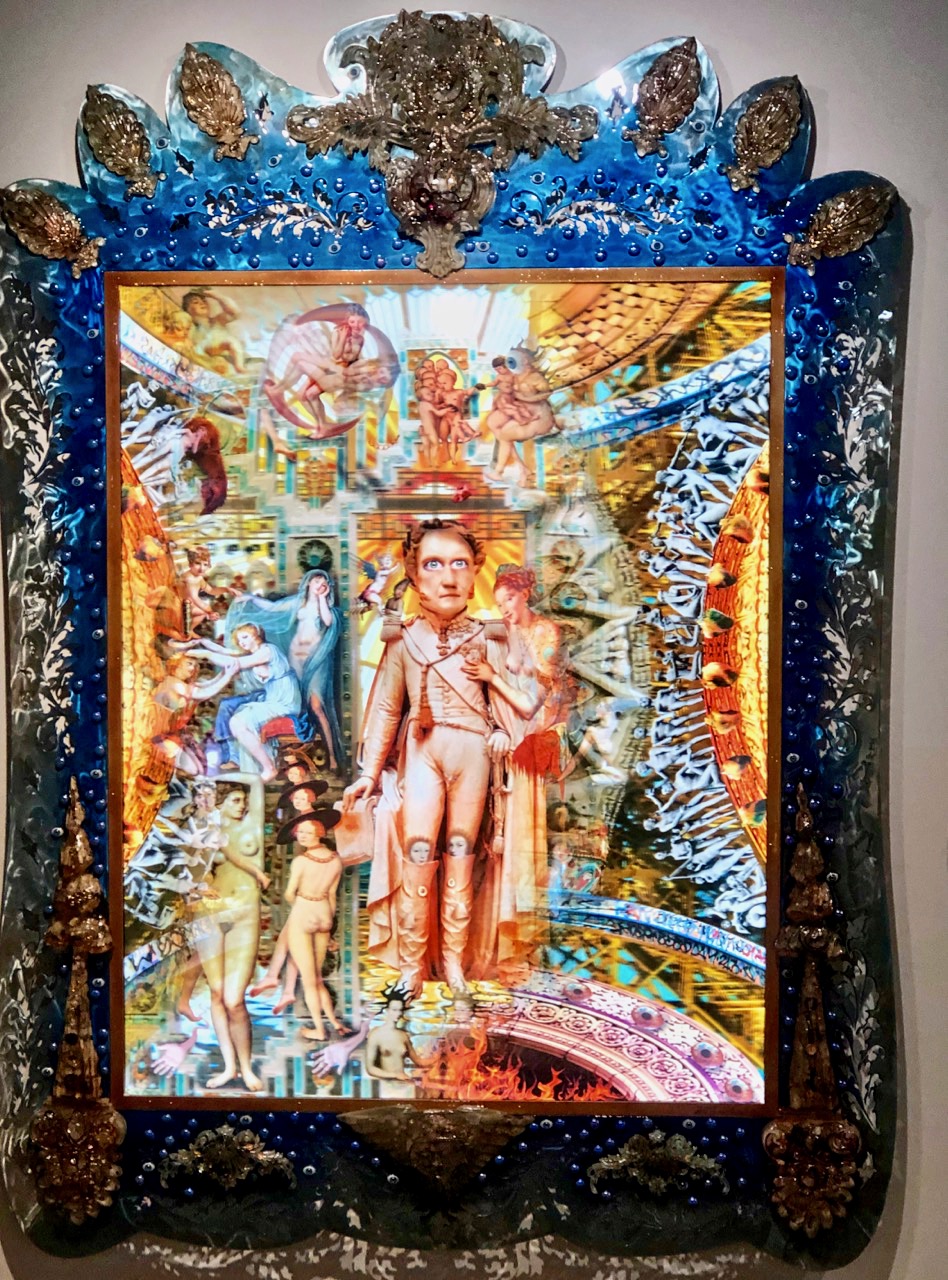
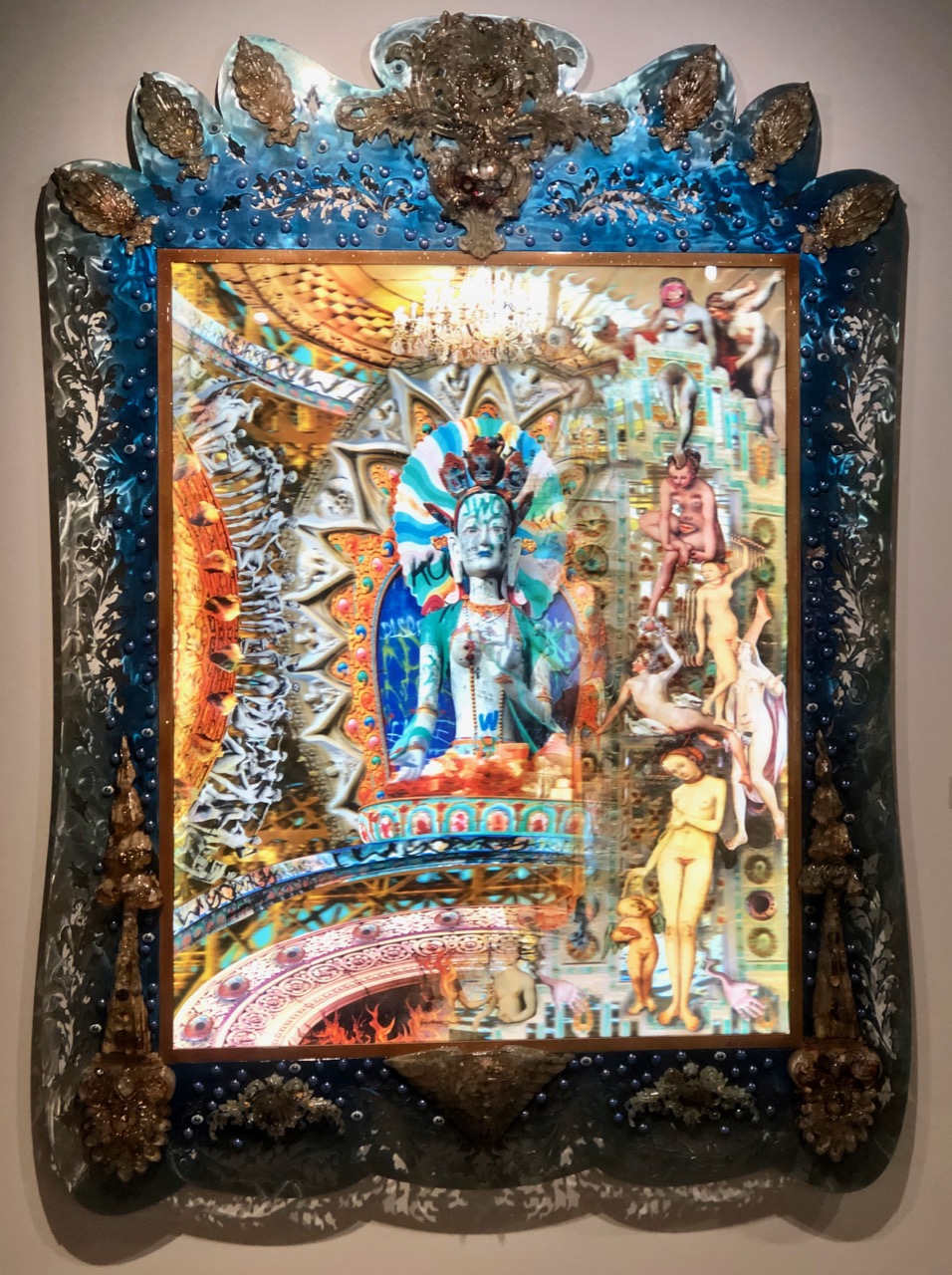
Finally, “Feminencia” will make you take a second look, because when you move, the entire focus is changed. Once again, this piece incorporates lenticular printing, which gives the viewer an illusion of movement. First, I saw King Leopold I of Belgium surrounded by a lot of naked women (it’s good to be King). Make a slight movement, however, and I was now looking at The White Tara, a very important figure of Buddhism.
In the ARTnews article, Marin said, “My mantra during all these years has been: You can’t love or hate Chicano art unless you see it. You can have an image of what you think it’s going to be, but when you see it in person, it is totally different from what you presumed.” His ultimate goal was to “get as many people as possible to see Chicano art.”
 Our
advice is the same as Cheech Marin’s … Just go see it! Chicano art may
not be everybody’s cup of mezcal, but it sure is now for us. The museum
turned out to be exhilarating, enticing and enlightening … definitely
one art museum that I can see us revisiting on a number of occasions.
Our
advice is the same as Cheech Marin’s … Just go see it! Chicano art may
not be everybody’s cup of mezcal, but it sure is now for us. The museum
turned out to be exhilarating, enticing and enlightening … definitely
one art museum that I can see us revisiting on a number of occasions.
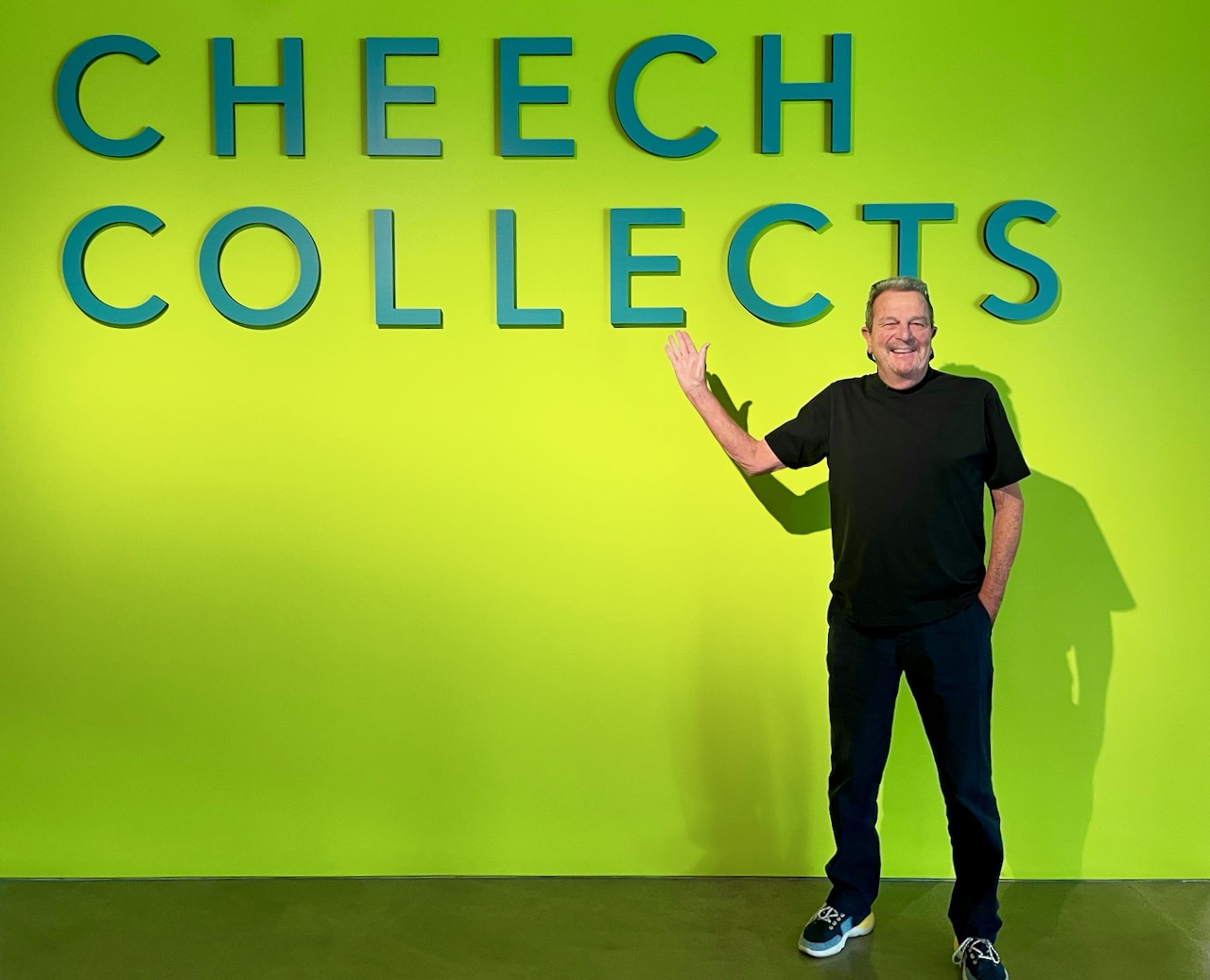
Oh, by the way, don’t bother to ask at the desk, because “Dave’s not here.”
Mai Tai Tom Tip: Afterward, take a little time to walk across the street and check out the historic Mission Inn, and perhaps sit in the President Taft Chair. I can pretty much guarantee you’ll fit.
The Cheech Marin Center for Chicano Art & Culture of The Riverside Art Museum
3581 Mission Avenue
– Riverside, CA 92501
Phone: 951-684-7111
Hours: Wednesday – Sunday 10 a.m. – 5 p.m.
$15.95
$10.95 seniors, educator & College students …proof of ID required, and children 13 – 17 years old
Children under 12, military personnel & RAM members free
Metered street and lot parking is available along Mission Inn Avenue
https://riversideartmuseum.org/visit/the-cheech-marin-center-for-chicano-art-culture/