Showing posts with label Lisa Sette Gallery. Show all posts

Monday, January 5, 2026

Natural Intelligence, Lisa Sette Gallery’s first show of 2026, considers nature as a timeless creative source, endlessly generating mysterious and infinite meanings. Jan. 10-Feb.28, 2026

JANUARY INVITATION

Mayme Kratz Eclipse 5, 2025 resin, bones, The Sea Ranch shells, wasp gall, Texas laurel seed, horse tooth 24" x 24"

NI: Natural Intelligence

Group Exhibition
Exhibition Dates:
January 10 – February 28, 2026

Opening Reception with artists:
Saturday, January 10, 2026
1:00 - 3:00pm
NI: Natural IntelligenceLisa Sette Gallery’s first show of 2026, considers nature as a timeless creative source, endlessly generating mysterious and infinite meanings. This is in stark contrast to the closed digital systems of AI–while the purported “intelligence” of large data sets is circumscribed by the limits of human experience and technical capacity, nature’s systems are universal and exist primarily outside of human comprehension. In fascinating forms and unexpected materials, the artists of NI: Natural Intelligence offer us poignant and intriguing pathways into the enigmatic domains of nature and the ever-expanding cosmos.

Lisa Sette observes “In contrast to AI, nature is intelligent far beyond human speculation. These artists focus on the inherent beauty and intelligence of the natural world as a solace in our fraught world of plastic and screens.” Featuring works by, Kim CridlerAla EbtekarCarlos Estévez, Máximo GonzálezTimothy HornAlan Bur JohnsonMichael KoernerMayme KratzDavid KrollMarie NavarreBeverly PennBenjamin TimpsonFrances Whitehead
and Xawery WolskiNI: Natural Intelligence opens with a public reception on Saturday, January 10 and continues through February 28, 2026.
Click to Preview Exhibition
 
top (left): Benjamin Timpson Homero Gómez González, 2025 unique butterfly wings on glass, wood, electrical components 16" x 12" butterfly collage 20 5/8" x 16 5/8" x 2 3/4" framed dimensions framed within custom programmable LED light panel
top (right): Kim Cridler Return, 2025 steel, sterling silver, rose cut aquamarine 24" x 13" x 12"
bottom: David Kroll Seascape Egret and Vase, 2025 oil on linen 48" x 60"
 

LISA SETTE GALLERY

210 East Catalina Drive
Phoenix, Arizona 85012
480 990 7342

GALLERY HOURS

Tuesday - Friday 10am - 4pm
Saturday 11am - 4pm
(Closed Sundays and Mondays)
Lisa Sette Gallery
210 East Catalina Drive
Phoenix, AZ 85012

Wednesday, January 3, 2024

LISA SETTE GALLERY Exhibits: TRANSCENDENT GEOMETRIES: ATO RIBEIRO AND CARRIE MARILL WITH ANDY BURGESS


TRANSCENDENT GEOMETRIES:

ATO RIBEIRO AND CARRIE MARILL
WITH ANDY BURGESS


Transcendent Geometries
Ato Ribeiro | Carrie Marill
with Andy Burgess


Exhibition Dates:
March 2 – May 25, 2024

Opening Reception with the artists:
Saturday, March 2, 2024
1:00 - 3:00pm

In a time dominated by machine algorithms, a return to patterns made by human hands and touched by human bodies can produce transcendent geometries, reminding us of our origins as embodied and sensuous beings. Ato RibeiroCarrie Marill, and Andy Burgess work in diverse media, yet each artist employs pattern as an instrument of exquisite narrative and intimate intention. Working within formal geometrical guidelines that often resemble the composition of a quilt – an object used both to warm people and communicate information – Ribeiro, Marill, and Burgess combine tactile materials, mathematical constraints, and the universal need for expression to create intimate graphic explorations in wood, acrylic on linen, and textile collage. Their recent works will be exhibited in a group show at Lisa Sette Gallery from March 2 – May 25, 2024.

Ato Ribeiro constructs vibrant compilations of motifs, patterns, and structures that multiply and evolve before the viewers’ eyes. Handmade of salvaged scrap wood – a metaphor for the bodies of historically disadvantaged peoples – Ribeiro’s arrangements of hand burnished wood pieces and right angles form voluminous landscapes of pattern and movement, celebration and remembrance. A collector of symbols and stories as well as wood, Ribeiro formulates these works with reference to his Ghanian background and the diverse cultures of the African diaspora, blending the patterns of Kente cloth and African American quilts – objects worn close to the skin and signifying family, status, and values – as well as the formulations of griot storytelling, woman-led justice work, and his own extensive travels. From this rich personal background Ribeiro draws forth ever more expansive communications of action, intimacy, and family. Ribiero remarks that these works “serve as a reflection of the people, the histories, and the cultural fabrics that I continue to learn from and share in. These works are a collection of stories, fragmented and fused together with room for the addition of narratives to come… This assemblage of histories pays homage to my three-times great grandmother Priscilla (Marshall) Young, interactions with griots, and my desire to share space and stories with Madan Sara in Haiti. The materials that make up these works are the same ones that make up the hard and soft woods hidden behind white gallery walls. Here, they are optimistic for the future because they know from whence they came.”


The artist Carrie Marill speaks of her “love for combining worlds,” and her research and practice examining pattern, color, and form in both folk and fine art result in works that are luminously personal and formally precise. Marill lists the contrasts that inspire her, from “craft and architecture, masculine and feminine, beauty and utility” to “hard and soft, structure and freeform, handwork and mechanization.” In Marill’s recent works, inspired by her study of European modernist architects and folk quilts, the artist delineates these human contrasts in geometrical explorations. The personal characteristics of built spaces and objects are tangible in these works: the simple physique of a chair, the human spaces around which a building is built, the soft precision of a quilt made from textile remnants already worn close for a lifetime.  “I have been looking at architecture and how the patterns found in modern/minimalist architecture utilize similar patterns as found in quilt making. Architecture can create light, airy space out of steel, metal and concrete. Could quilts create a similar effect? What if a building were a quilt? I want to capture that in a painting.”


Similarly, Andy Burgess’s elegant assemblages of found textiles and paper ephemera recall deeply personal architectures: the receding horizons of imaginative cityscapes, the parallel and bisecting lines of books standing vertically in a shelf, or the intricate repeating unit of a quilt square. Burgess explores space and pattern with references to the modernist movement and “the place of collage within that history, exploring the aesthetic legacy of Cubism, Bauhaus, Dada, and Constructivism.”  Yet within these compositional strategies, Burgess values the touch and texture of his materials above all, selecting his compositions from a vast tactile catalog of found materials documenting human lives and the materials we use and discard: “I make art from the most humble and lo-fi materials…found ephemera, discarded papers and card, and recycled offcuts from previous works. The more dejected and rejected, dog-eared and forlorn are my materials, the greater the possibility that a careful repurposing and delicate arrangement of elements can turn the abject into something beautiful and poetic… By making humble and small-scale works from repurposed materials that are full of imperfections; uneven and worn surfaces, tears, fissures, cracks, and fractures, I hope to make a small statement about the continued vitality and significance of the hand-made art object.”

Ribeiro, Marill, and Burgess’s generative action through geometrical constraint creates patterns, structures, and moments of introspection, accessing experiences of interior consciousness and human sensuousness. These works evoke an awareness of the shapes and patterns that humans have constructed, touched, broadcast, and lived within for centuries and throughout the world.  Their distinct graphic explorations speak of the shape of human curiosity and variety, and our simultaneous ability to organize the symbols and structures of our lives into lucid moments of sensation and self-knowledge.


To request high resolution images, please contact us at (480) 990-7342 or email us at sette@lisasettegallery.com.

For 38 years, Lisa Sette has remained committed to discovering and exposing original, intriguing forms of expression. Lisa Sette Gallery exhibits painting, sculpture, photography, video, installation, and performance pieces from an impressive roster of emerging and established artists, as well as maintaining a clientele of local and international collectors devoted to its founder’s adventurous curatorial vision.


Images
1)
 Ato Ribeiro Madan Sara, 2023, Repurposed wood, HDPE, wood glue, 48” x 72” x 1.25”
2) Carrie Marill Positive Illusions, 2023, Acrylic on linen, 36” x 30”
3) (left) Andy Burgess The Airfield, 2023, Vintage ephemera and painted paper collage, 4.5" x 3.5" unframed
4) (right) Andy Burgess The Daily Commute, 2023, Vintage ephemera and painted paper collage, 4.5" x 3.5" unframed


Monday, October 2, 2023

Lisa Sette Gallery Exhibits: Shadow Passes, Light Remains: Binh Danh and Michael Koerner with Benjamin Timpson, January 13, 2024 – February 24, 2024

Lisa Sette Gallery

Share


SHADOW PASSES, LIGHT REMAINS:

BINH DANH AND MICHAEL KOERNER


WITH BENJAMIN TIMPSON IN THE ATRIUM

Shadow Passes, Light Remains:
Binh Danh and Michael Koerner
with Benjamin Timpson in the Atrium

Exhibition Dates:
January 13, 2024 – February 24, 2024

Opening Reception with the artists:
Saturday, January 13, 2024
1:00 - 3:00pm

In the peculiar alchemy of photography, fleeting configurations of light and shadow are transformed into images and objects, capturing a moment, a landscape, a life. In the present moment, when images proliferate and their meanings multiply into an infinity of implications, the experimental photographic works of Michael Koerner and Binh Danh serve as serene documentation of humanity’s deep chemical and mythological lineages. From the aqueous origins of our dark past to the electric thread of current consciousness, we grow in our capability to perceive, comprehend, and transform. Koerner’s poetic chemical assays and Danh’s gleaming testimonial daguerreotypes remind us that we are defined, both physically and philosophically, by values of light and shadow, and that from the shadows of the darkroom, captured light becomes the bright evidence of our existence, humanity, and capability to make and behold beauty. A selection of works by Koerner and Danh will be exhibited at Lisa Sette Gallery along with a single work by Benjamin Timpson, from January 13 to February 24, 2024, with an opening for the artists on January 13, 2024 from 1pm - 3pm.

In processing his fascinating tintype plates, artist and chemist Michael Koerner communicates with his lost family in the darkroom; his mother and her family, who were living in Nagasaki at the time of its bombing; his father, who served on a Navy ship during the Bikini Atoll nuclear experiments; and his siblings who perished due to cancer and other genetic anomalies. The voices and traumas of the past inform Koerner’s experiments, illuminating parallels between genetic mutation and the exuberant crystalline fractals that burst unexpectedly from Koerner’s timed chemical exposures. Acid and salt solutions on coated metallic plates result in unpredictable chemical transfigurations, resembling blossoms, clouds, or ghostly limbs, reaching across the photographic surface, transforming the narratives of war and loss into stunning repositories of light and form.

Koerner’s works can resemble otherworldly landscapes or radiological medical images, as though with the chemical tools of photography the artist has unlocked a subconscious realm, producing windows into the wordless places of loss, yearning, and hope. In these spaces, which are dense with texture and contrast, Koerner tells the story of war’s effects through generations. “In the darkroom,” says Koerner, “It’s all spiritual and emotional. Eventually, suffering must be processed here.” However, the drive to make art is an equally insistent and powerful force in Koerner’s life, a medium wherein his ancestral cultures, his family’s love, and his own scientific and aesthetic examinations result in prolific and profound works. “There’s beauty in this damage,” Koerner states.

In the ethereal reflective surfaces of Binh Danh’s large-scale daguerreotypes, and in the images’ paradoxical subject matter, the viewer is invited to explore the issues of self, creativity, and our simultaneous tendency toward destruction. His portraits of the locations and victims of the Khmer Rouge genocide, many exposed on the delicate surface of a leaf, then transferred to daguerreotype, recall the complex arterial nature of exquisite bas-relief scenes on the temples of Angkor Wat, which are also the subject of several of Danh’s images.

With Angkor Wat,” says Danh, “here is this beautiful architectural achievement of art and religion and Buddhist culture. And it was through the beauty of the Angkor Wat temple that the Khmer Rouge emerged, as the regime sought above all to return Cambodia to its glory days. In order to do that, they had to remove anyone who did not go along with their ideology. This is a theme I return to: the darkness and beauty in our history.

Danh’s poignant, unflinching memorials capture both the moral collapse represented by Tuol Sleng–a former high school turned Khmer prison and execution site–and the sublime deep forests and structures of Angkor Wat. These works invite the viewer to consider how our existence is part of a larger narrative in human history, one that involves both sorrow and transcendence. When you look at the mirror-like surface of a daguerreotype, Danh remarks, “You become part of the image. You are able to reflect yourself onto this landscape.

The intensely silver surfaces of Danh’s works often seem to result in a vibration of shadow and light around the subject’s edges, as though in the photograph we may finally glimpse the complicated interplay of matter and energy inherent in all life. Whether in the stark chambers of injustice or the luminous expressions of monumental gods, Danh’s images record the hidden magic at play in human endeavors. As we contemplate the machinations of human destruction, we are at the same time living in the shadow of the Buddha’s form, rising up from the forest floor.

For both Koerner and Danh, processing darkness into light in photographic work is a strategy for bearing witness to the immense mystery of our human existence, bringing forth from the darkness an opportunity to bask in the light of this moment. 

In the Atrium: Benjamin Timpson

Benjamin Timpson at Lisa Sette Gallery

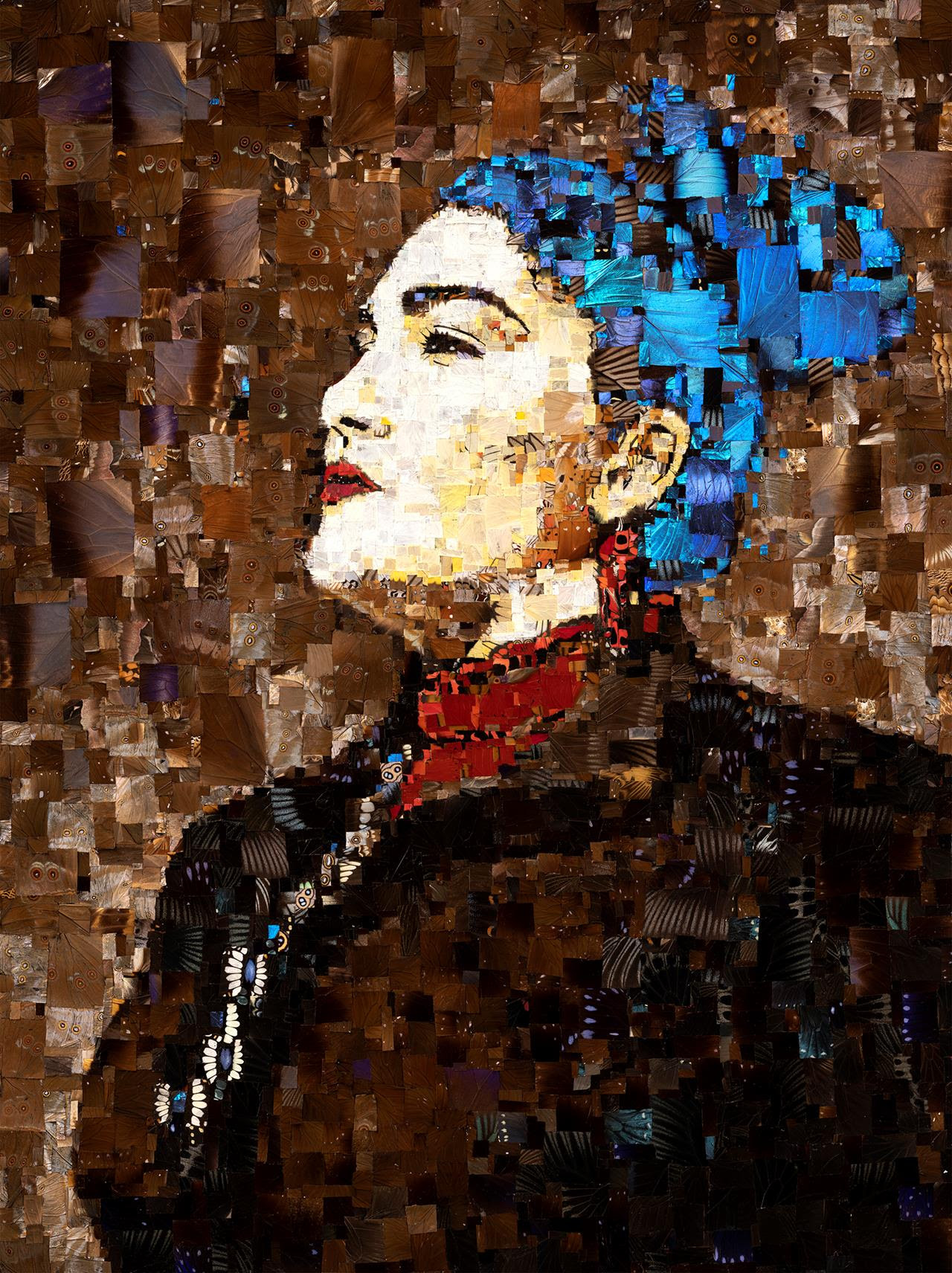
Benjamin Timpson’s luminous portraits are constructed of butterfly wings, each visage delineated through mysterious patterns and complex interplay of color and iridescence. The delicate biological relics are responsibly sourced by the artist, deconstructed according to their unique markings, then pieced over the artist’s rough sketch on a lightbox.

A descendant of Puebloan peoples, Timpson’s transcendent works portray Indigenous women who have been the victim of sexual assault and murder – a population that is four times more likely to experience such violence.

Timpson’s newest piece, Melodi, is a composition made from a Jeffrey Wolin photograph taken for his Faces of Homelessness series. Melodi, a survivor of sexual assault and domestic violence, is a 5th generation veteran who now works to advocate for special needs, education, and the Native American community in Chicago, Illinois.

Timpson sees these portraits as a metaphor for the significance of individual lives impacted by cultural violence, and as a way of examining the horrors of centuries-long exploitation of Native lands and cultures. Yet Timpson considers his work an act of hope and catharsis. The artist remarks: “The butterfly is appropriate because there’s a metamorphosis that takes place with these portraits; my work is about giving voice to the voiceless, and bringing to light the lives of these women.

To request high resolution images, please contact us at (480) 990-7342 or email us at sette@lisasettegallery.com.

For 38 years, Lisa Sette has remained committed to discovering and exposing original, intriguing forms of expression. Lisa Sette Gallery exhibits painting, sculpture, photography, video, installation, and performance pieces from an Images

1) (left) Binh Danh Untitled #19, from the series, "Aura of Botanical Specimen", 2023, photogram on Daguerreotype, 5" x 7" plate size, 11" x 9" unframed, Unique
2) (right) 
Michael Koerner Brothers #0655from the series My DNA, 2018, collodion on tin, 6 x 8" unframed, Unique
3) Benjamin Timpson Melodi, 2023, butterfly wings on glass, wood, electrical components, 24" x 18" portrait, framed within custom programmable LED light panel, Unique