|
Tuesday, May 2, 2023
Apply to the Rose Squared Art Shows in New Jersey this Year. See details below!


Thursday, April 27, 2023
Fright & Volume, Opening Reception: Friday, May 5th 6:00 - 8:30 PM
 | |||||||||||||||||||||||||||||||||||||||||||||||||||||||||||||||||||||||||||||||||||||||||||
|


Apply to the SATELLITE ART SHOW at the Art Basel Switzerland fair!
 |

|





Wednesday, April 26, 2023
Between Lichtenstein and Riley: Exploring Color
Between Lichtenstein and Riley: Exploring Color
Both Roy Lichtenstein and Bridget Riley searched for an essence that lay behind the subject of portrayal, using color to affect their audience
Bianca Spaggiari / MutualArt
Apr 25, 2023
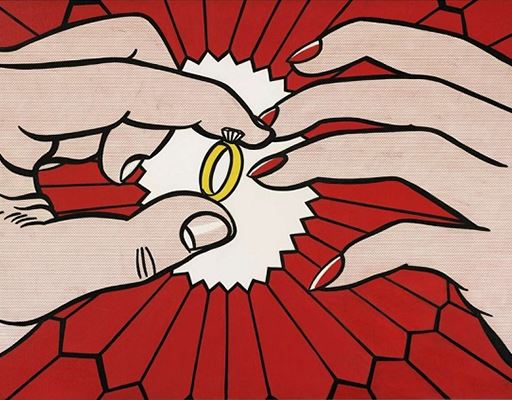
Art is a quintessential element of life and can often be a guide towards dealing with the dilemmas of everyday life, a key towards understanding — on a deeper level — the circumstances and situations we face. Although one premise is that art takes after the human soul, it is also the meeting point between reality and the surreal. Considering art as the convergence of actuality and imagination and using it as a means to decipher things can be a highly appealing approach to the subject. Furthermore, the deciphering of meaning veiled behind the canvas is effective in grasping an artwork. The process can also shed light on hidden connections and interactions that often get lost in the narratives when comparing different artists, from the same period or not.
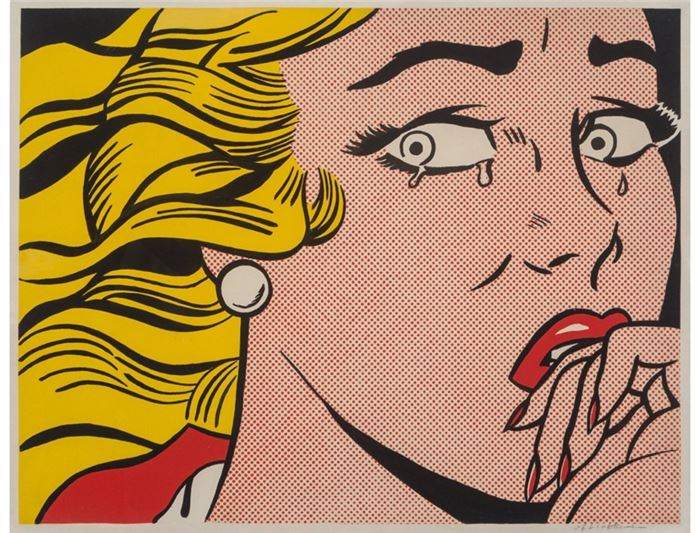
Roy Lichtenstein, Crying Girl, Offset lithograph on lightweight, off-white wove paper, 45.8 x 61 cm, 1963. Courtesy of Clars Auction Gallery
Roy Lichtenstein was born in New York in 1923 and grew up on the Upper East Side. After training at Parsons School of Design, specializing in watercolor classes too, he had a very prolific career entering the roster of the most renowned art galleries of New York at the time, including Leo Castelli. Leo Castelli Gallery, perhaps the most prominent commercial venue in the art world at the time, presented Roy Lichtenstein’s first solo show, a sure-fire with good results in terms of fame and profit.
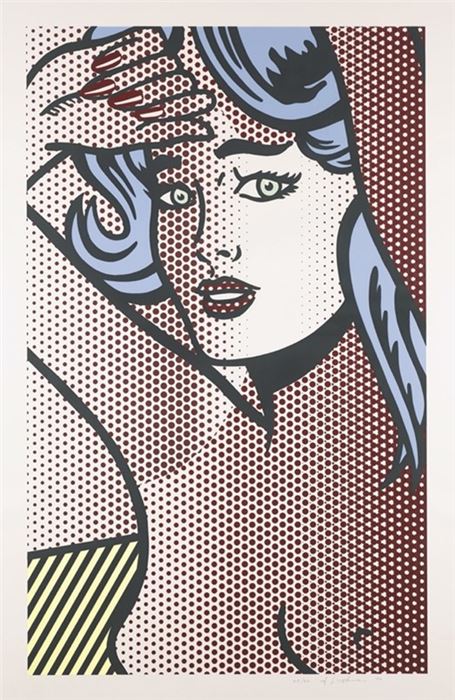
Roy Lichtenstein, Nude with Blue Hair, relief prints in colours, 130 x 80 cm, 1994. Courtesy of Sotheby’s London
During his artistic days, Lichtenstein employed a rotating easel to let him turn the canvas all the way around and be able to paint on it from every angle and in every direction. He himself affirmed, “I often paint my pictures upside down or sideways. I often do not remember what most of them are about. The subjects aren’t what holds my interest.” Neither would he confine himself to just canvases, often engaging with mixed media like ceramics and sculptures, but also industrial materials such as plexiglass.
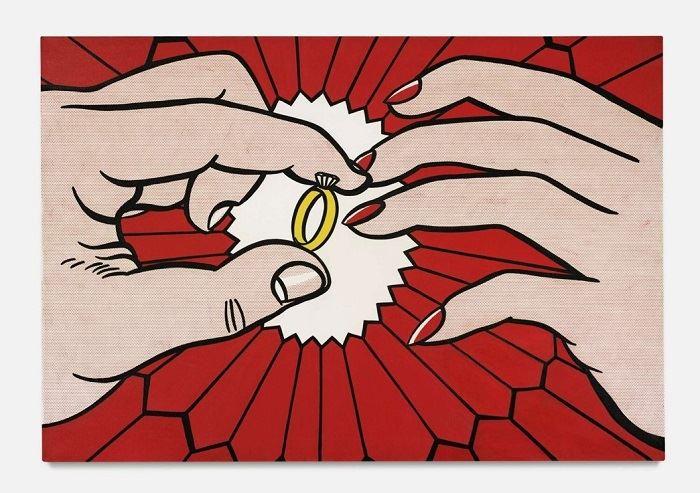
Roy Lichtenstein, The Ring (Engagement), oil on canvas, 121.9 x 177.8 cm, 1962. Courtesy of Sotheby’s New York
Lichtenstein was daring in his approach and would use mostly bold color combinations, and his portrayals expanded to things beyond just the painting. Since he was neither depicting reality nor non-reality, the symbolism behind his works was often as suspended in the air, frozen in time, as the subject itself, like in The Ring (The Engagement). The canvas portrays the immediate moment preceding an engagement. Is he trying to take a snapshot of eternity? Or is he trying to communicate that marriage is an endless quest for happiness never to be found? The intrinsic meaning behind the canvas remains unsolved, just like the ring will never be slipped onto that lady's finger. The stark contrast between the couple's hands and the red background puts the spotlights on the ring. However, it also imbues the scene with a sense of anxiety due to the red spiky panes pointing towards it.
In contrast, British artist Bridget Riley was born in 1931 and is among the most celebrated contemporary artists. Riley started by painting figurative subjects, in her early phase mainly producing landscapes, with a rather academic approach, and later shifted to pointillism. Georges Seurat was highly influential on her, to the point where she internalized his practice, which helped her create her own trademark style. In 1960 she began exploring the dynamic potentialities of optical phenomena, producing the so-called Op-art pieces. Today her artworks are powerful in the human emotional response and able to make people feel seasick or overwhelmed. Therefore, like Lichtenstein, Riley infuses the audience with a sense of augmented reality and sometimes a state of non-tranquility.
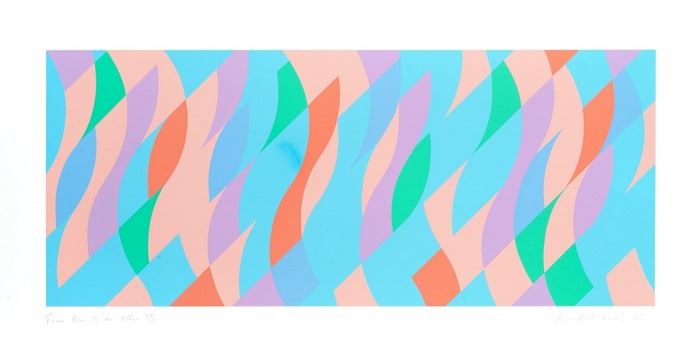
Bridget Riley, From One to the Other, screen-print in colours, 49 × 92.1 cm, 2005. COurtesy of Bonhams Knightsbridge, London
From One to the Other is a continuum of lines in four different colors, but the viewer never perceives the elements individually. Waves of blue (and a darker shade of blue), violet, pink, and orange are weaved together. The pattern is thoughtfully studied, happening over sequences. Combining changing colors and twirls gives the viewer the impression of motion in the painting as the lozenge shapes surf over the canvas, vertically and horizontally. Just like Lichtenstein searched for deeper meaning beyond the figurative essence, the same applies to Riley. The lack of an iconographical presence calls for a deeper analysis to understand the overall abstraction’s meaning. Maybe it is all to be found in the title, a possible reference to the sweeping instances of life, as we move in waves flowing from one point in time to the next.
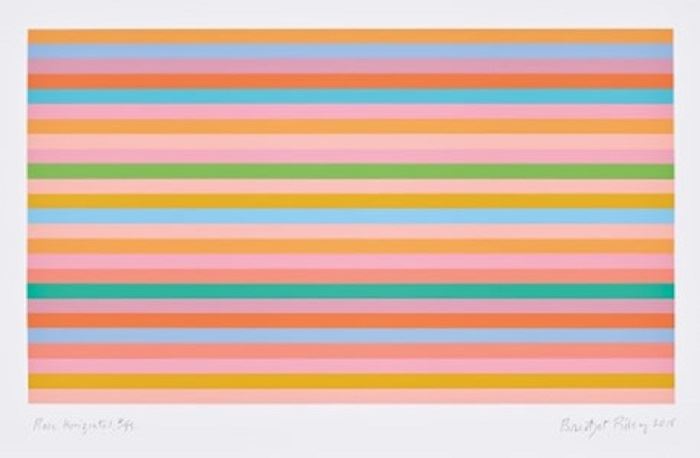
Bridget Riley, Rose Horizontal (T & G. 91), screen-print in colours on Fabriano paper, 47.9 x 82.4 cm, 2018. Courtesy of Phillips London
Comparing the oeuvre of the two, many similarities are discernible. Departing from what pleases the human eye, both artists reveal strong affinities as they engaged with pointillism or highly geometrical patterns throughout their careers. Lichtenstein’s motifs are more figurative, but as mentioned, the artist had “interest in anything emotionally strong.” Riley, avoiding Lichtenstein’s stark contrasts, focuses on softer and subtler nuances. Both, however, present individual explorations of color that reveal visual connections which affect when applied close to another, presenting a deep understanding of how the interaction of color functions inside a defined space and how this results in distinctive, visually vibrant compositions.
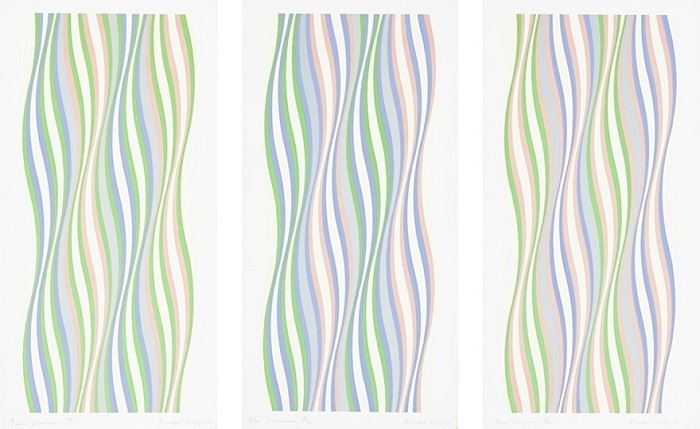
Bridget Riley, Green Dominance; Blue Dominance; and Red Dominance (Schubert 22 - 24), screen-print in colours, 88.3 x 39.3 cm each, 1977. Courtesy of Sotheby’s New York
Given the consistent engagement with color, it is safe to say that notwithstanding the figurative or non-figurative subject matter on the canvas, there is a thread between the artistic approaches of Roy Lichtenstein and Bridget Riley. In their quest to convey meaning, Lichtenstein and Riley's vision went far beyond reality, expanding the canvas’ physical dimensions into a crafted reality they constantly created when making art — the representative fades away, what is left is the pure and intrinsic essence. If art can guide us through the dilemmas of life, it can also craft new dilemmas.
For more on auctions, exhibitions, and current trends, visit our Magazine Page
Subscribe to:
Comments (Atom)