|
|
|

|
|


|
|
|

|
|
|
|
|
|
|
|
|
|
|
|
 |
Magazzino Italian Art's 2023 Program Highlights  Magazzino Italian Art campus. Photo by Jacobo Mingorance. Magazzino Italian Art campus. Photo by Jacobo Mingorance.Magazzino Italian Art is pleased to announce a new slate of programs for the upcoming year. The calendar will highlight a program series curated by Ilaria Conti on diversity in art and culture across Italy and the United States, a lecture series on new scholarship in the study of the Arte Povera movement curated by Dr. Roberta Minnucci, Magazzino Italian Art 2022-23 Scholar-in- Residence, a project by Arcangelo Sassolino in collaboration with The Art Newspaper, a cross-genre concert by Jog Blues, and the sixth iteration of the Cinema in Piazza film series presented in partnership with the Cold Spring Film Society and Artecinema, Naples. Magazzino’s summer programs will culminate in the September opening of the museum’s second building: the Robert Olnick Pavilion. |
Pensiero Plurale |
Arte Povera: Artistic Tradition and Transatlantic Dialogue |
Arcangelo Sassolino  Arcangelo Sassolino. Photo by Agostino Osio. Arcangelo Sassolino. Photo by Agostino Osio.This talk and presentation, in collaboration with The Art Newspaper, will present the work of artist Arcangelo Sassolino whose sculptures and installations explore mechanical behaviors and properties of force. The event, culminating in a lunch, will feature curators and critics including Chiara Parisi, Hans Ulrich Obrist, and Francesco Manacorda, and both indoor and outdoor sculptures and installations on loan to Magazzino. |
Artists' Writings: The Case of Salvo and Barbara T. Smith  Benedizione di Lucerna, 1970/75, black and white photograph on aluminium, 43.3x34.6 in. (110×88 cm). Courtesy Gerd De Vries Collection, Berlin. Benedizione di Lucerna, 1970/75, black and white photograph on aluminium, 43.3x34.6 in. (110×88 cm). Courtesy Gerd De Vries Collection, Berlin.On the occasion of the publication of IO SONO SALVO (NERO Editions, 2023), Lisa Andreani, member of the Archivio Salvo, will be in dialogue with Pietro Rigolo, Associate Curator at the Getty Research Institute and co-editor of the newly published memoir of performance artist Barbara T. Smith (The Way to Be, Getty Research Institute 2023). The conversation will focus on artists’ autobiographical writings and their significance, and will be moderated by Magazzino Italian Art 2022-23 Scholar-in-Residence Roberta Minnucci. This project is supported by the Italian Council (10th edition, 2021), a program to promote Italian contemporary art in the world by the Directorate-General for Contemporary Creativity of the Italian Ministry of Culture. |
Jog Blues |
Cinema in Piazza |
Mario Schifano |
Ettore Spalletti |
Carlo Scarpa |
Arte Povera |
Carlo Scarpa Study Day |
Ettore Spalletti Study Day |
Mario Schifano Study Day |
| |||||||||||||||
|

Chosen to be among an illustrious roster of painters to create monumental SF murals, Frank Brangwyn was the only non-American, influencing an entire genre of Californian art
Michael Pearce / MutualArt
Feb 08, 2023
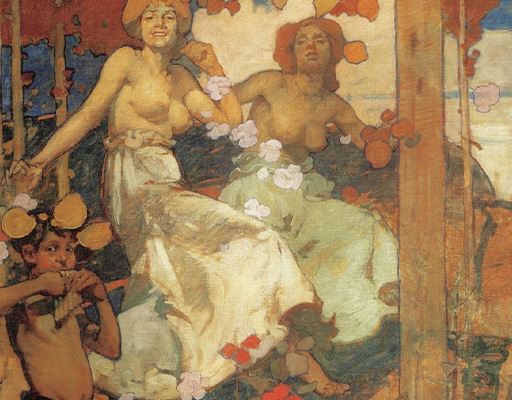
When the organizers of the Panama-Pacific Exposition of 1915 chose the muralists who would create the immense paintings that decorated the spectacular palaces dominating the San Francisco shoreline for the year of the great event, they tapped Childe Hassam, Charles Holloway, Arthur Mathews, Robert Reid, Milton Bancroft, Edward Simmons, Frank Du Monde, and William Leftwich Dodge as American painters at the peak of their careers, exemplifying the excellence of the nation’s artistic quality. But they bent the thumb of their nationalist rule to include Welshman Frank Brangwyn, the prolific muralist and artistic éminence grise, whose fame trumped his citizenship, and paid him to execute eight spectacular paintings, each twenty-five feet high and twelve feet wide.
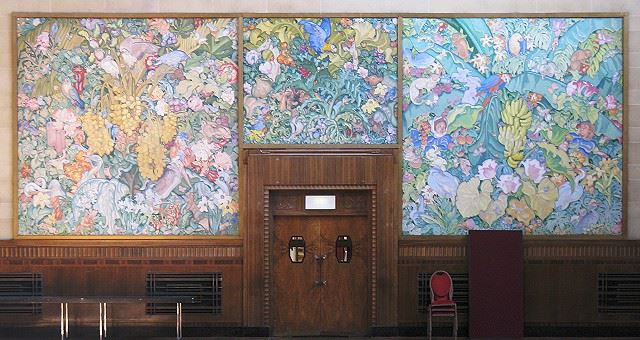
Frank Brangwyn, British Empire Panels in the Brangywn Hall, Swansea. Photo by Nigel Davies
Once a teenage apprentice to William Morris, the great arts and crafts guru, by 1915 Brangwyn was one of the few artists whose prolific reputation matched the immense scale of the exposition. He was absurdly productive, producing thousands of paintings, drawings, murals, furniture and carpet designs during his lifetime. In Art in California, a lavish official tome produced to describe the exposition’s exuberant displays of paintings and sculptures, critic Hamilton Wright was overcome by the quality of Brangwyn’s murals and began his descriptions of the imagery with his compliments to the master. In his essay he “…marveled at the wonderful ornamental quality and brilliance of these great friezes of color,” and was so impressed that he included images of all eight as illustrations to his essay, to compare to the rough preparatory sketches of the other painters.
Jules Guérin, the art director of the exposition, enforced strict control over the color palette of every building and painting, and even ordered the sand that lined the pathways to be baked in ovens to precisely match the travertine of the extravagant palaces. His pastel greens and reds, balanced with salmon pinks and soft blue were a potent and popular combination which influenced Californian architects and decorators for generations. Guérin insisted that the muralists work in San Francisco so he could supervise their obedience and guide their labor, but made no attempt to enforce any control over mighty Brangwyn, who was allowed to paint without restraint in his London studio.
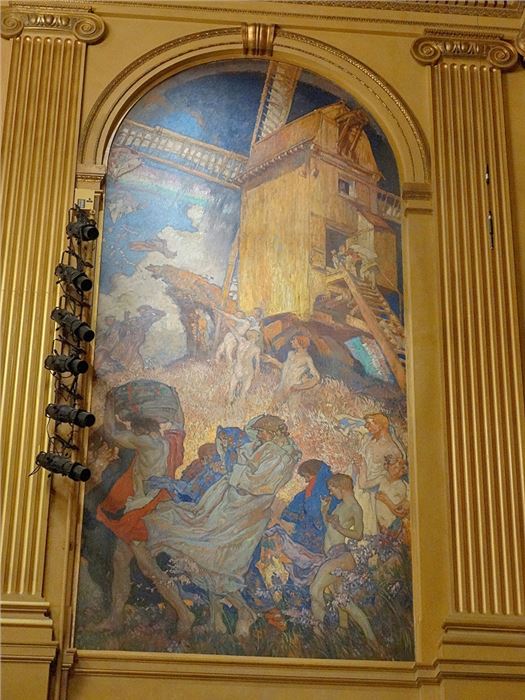
Frank Brangwyn, Mural, The Windmill, Courtesy of The Master's Light Photography
Brangwyn’s huge murals dominated the lavish Court of Abundance, a fantasy of Moorish and Gothic architecture set around the long arcades of a formal garden. Beautifully rendered figures dominated his elemental paintings, and he used the great height of the tall canvases to initiate fantastic images of weighty produce passed down, and raised spectators’ eyes up to the heavens. America, now united from shore to shore, was a wealthy land of fecund plenty. An extravagant harvest of fertile profusion was brought to ground in The Fruit Pickers, and bursting clusters of black fruit were gathered from high trellises in Dancing the Grapes. A windswept procession of laden travelers passed before joyful naked kite-flying boys beside the fragile tower and sails of The Windmill, the winged tower perched tilting on a boulder as if it was ready to fly away. The Hunters crouched over their arrows, muscle and tension hidden among tall thrusts of peeling eucalyptus. Fishermen hauled in a heavy load in The Net and brought huge baskets to fill with their unseen catch. In The Fountain jugs were carried on the heads of bearers, filled from an arc of spring water pouring from a breached crag. Pelicans passed among long purples and pink foxgloves. A high, thin helix of white and smoke twisted from a Primitive Fire, its small flames hidden by a cluster of absorbed men. In Industrial Fire active men pried open the door of a kiln, flames roared and a torrent of grey billowed into the air against a blue sky. Clusters of warm ceramics were the product of their sweating work. Brangwyn carefully avoided embodying air, earth, fire, and water as allegorical figures. He told the New York Times, "You will not find the usual girl flying in a cloud with a fish under her arm: or a woman sitting on a stage rock fanning herself with an eel and labeled 'Water.’ There is no blooming bit of allegory in the whole exposition – just an ordinary primal man and woman mixed up with the things of the earth. Not that I object to painting allegorical mural decorations generally; but I do object to allegory for America. I have always felt that it was incongruous to have allegory in a work destined for America. It is a strong, new country, and everything ought to be natural."
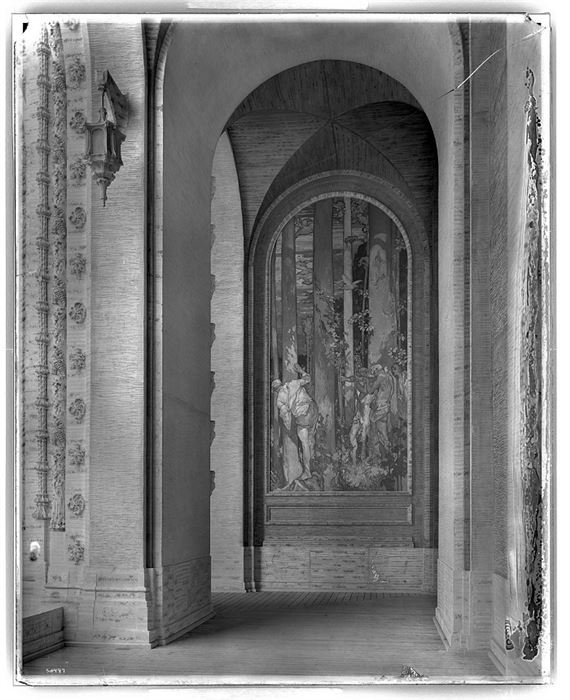
Frank Brangwyn's Air - The Hunters on site in the arcade of the Court of Abundance, Photo courtesy of UC Berkeley, Bancroft Library
After the exposition closed, Brangwyn’s superb murals were moved to the centerpiece gallery of the Palace of Fine Arts, the lavish Court of Ages, for the post-exposition exhibition. Visitors entered from a shady colonnade and placid lake through the main Eastern doors to be greeted by the lavish paintings, which were now the dominant decorative feature of the building, wrapped in the luxuriant frame of the exuberantly decorated architecture. They were accompanied by Charles Dickman’s repainted Bohemian Club seascape, Before the Storm, the original of which had been burned in the San Francisco fire of 1906, and Henry Fuller’s Carnegie-medal-winning allegory of Christian Science, The Triumph of Truth Over Error. Brangwyn exhibited thirty-nine prints in the international section a short walk away. Soon, when the nostalgic post-exposition exhibit closed, they were moved to the Herbst Theatre at the San Francisco War Memorial, where they still hang as glorious reminders of a generous golden age of civic gestures and grand gifts.
The influence of Brangwyn’s murals upon Californian art in particular was immense. His colleagues at the exposition created comparatively cautious images which did little to advance mural painting as an exciting, fresh field for creative exploration – but Brangwyn inspired artists who became giants of the burgeoning mural movement which lit up American art in the first four decades of the twentieth century.
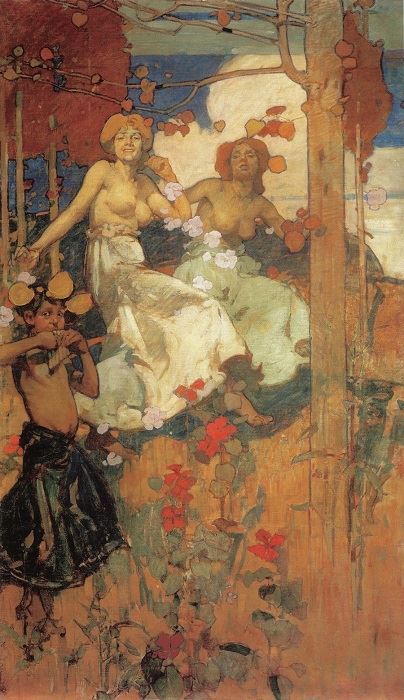
Frank Brangwyn - Dance
The great American illustrator Dean Cornwell worked for Brangwyn in England between 1927 and 1930 on the second series of the Skinners Hall murals and the British Empire panels. Cornwell went on to paint spectacular panels in the Grand Rotunda of the Los Angeles Central Library – rich, fluid compositions of an idealization and vision of Californian history, and these had a profound influence on the direction of art in Southern California as it developed as a home to light, visionary aesthetics, with a deep appreciation for calm sentiment. His romanticized figures were relaxed and natural, and in harmony with the idealized dream of California as a utopia of healthy living in a perfect climate – as a sanctuary for the good life. At the Lincoln Memorial Shrine in Redlands, California, Cornwell painted two symbolic lunettes, one celebrating Lincoln’s preservation of the American Union, and the other his liberation of the slaves. Around the lunettes, he painted a formal series of eight imposing allegorical figures, capturing Wisdom, Strength, Justice, Patience, Courage, Faith, Tolerance, and Loyalty as aspects of Lincoln’s character. The gentle colors of the library murals and the Lincoln Memorial are faithful to the palette required by Guérin at the Panama-Pacific Exposition.
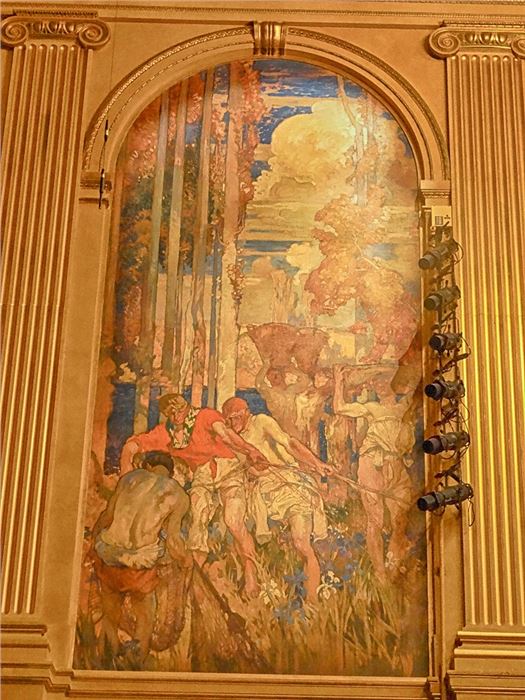
Frank Brangwyn, Mural, The Net, in the Herbst Theatre at the San Francisco War Memorial. Courtesy of The Master's Light Photography
Brangwyn’s assistant Allen Tupper True worked on the paintings at the exposition and supervised their installation. He worked for Brangwyn painting murals for Skinners Hall in London, and after 1918 he had a career in the United States as a prominent public painter, producing eight panels in the chambers of the Senate and the House of Representatives within the Wyoming State Capitol. He created sixteen more panels for the Missouri State Capitol and eight for the State Capitol of Colorado, where he painted dozens of walls for civic buildings until his death in 1955. He was chosen to paint four domes above the murals by Brangwyn in Jefferson City because his style was so influenced by the master.
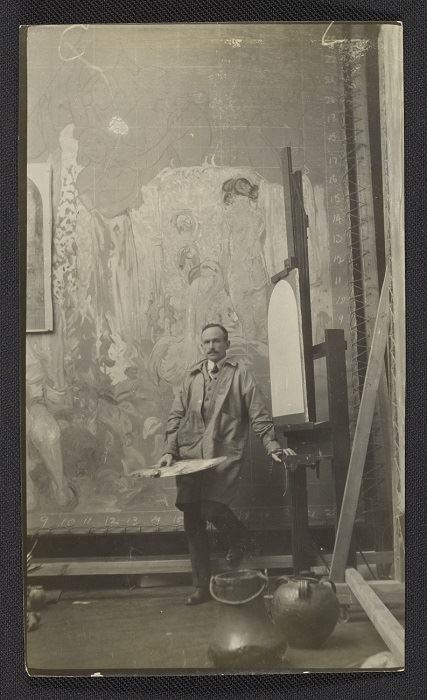
Allen Tupper True standing in front of an unfinished Frank Brangwyn mural, 1913-1915. Allen Tupper True and True family papers, 1841-1987. Archives of American Art, Smithsonian Institution
In 1911, American Edward Trumbull was Brangwyn’s assistant in London at his Temple Lodge studio. At the Panama-Pacific Exposition he painted two murals in the Pennsylvania Building – William Penn’s Treaty with the Indians, and The Steel Industries of Pittsburgh, and he went on to have an illustrious career as a muralist and illustrator in the United States, achieving international fame in 1930 for his overwhelming ceiling in the Chrysler Building, titled Transport and Human Endeavor, then the largest painting in the world, and prefiguring Diego Rivera’s efforts at the Detroit Institute and the RCA Building.
Exuberant Brangwyn bound them together. It was Brangwyn who introduced the fresh idealism of natural health to Californian art. It was Brangwyn whose imagination leapt from the stiff formulas of nineteenth century neo-classical idealism into a new figuration incorporating the sensual physicality of art nouveau. It was Brangwyn who tied together the celebratory spirit of new America with the beauty and bounty of the land. Seven million citizens visited the Panama-Pacific Exposition to experience the drama and spectacle of murals and sculptures and architecture. Among the painters, Brangwyn was the undisputed star.
For more on auctions, exhibitions, and current trends, visit our Magazine Page

61st Long Island Artists Exhibition Opens March 4th at the Art League of Long Island
The Art League of Long Island’s 61st Long Island Artists Exhibition, a biennial event, features 2-D
and 3-D works created by artists from Suffolk, Nassau, Brooklyn, and Queens. The exhibit will
be on view in the Art League’s spacious Jeanie Tengelsen Gallery March 4 through April 7. The
reception takes place Saturday, March 11, from 1:00pm to 3:00pm. A Gallery Talk with the
exhibition juror, Neill Slaughter, takes place on Thursday, March 30, from 7:00pm to 8:30pm.
The gallery, reception, and gallery talk are open to t
he public, and admission is free.
Exhibition juror Neill Slaughter, has selected 61 works out of the 675 submissions entered by 208 artists. The works selected for display in the gallery encompass a variety of artistic mediums and styles of art created by established and emerging artists.
About the Juror: Artist Neill Slaughter graduated with a BFA degree in 1975
from the University of Georgia and received his MFA in 1978 from Indiana University in
Bloomington. From 1978 until his retirement four decades later, Professor Slaughter taught fine
arts courses and art history at the university level (both in the US and England) as well as
exhibiting his drawings and paintings nationally and internationally. In 1993 Professor Slaughter
moved to Southampton NY from Los Angeles to begin teaching for Long Island University where
he was chairperson of the Art Department twice during his quarter century tenure with LIU.
Slaughter, now Professor Emeritus, resides in Southampton NY. During his forty years of
teaching, Professor Slaughter spent a considerable amount of time traveling throughout the
world to teach, conduct research and paint. His extensive travels have influenced what he
paints, which often reflect the social conditions of his surroundings. Among his awards and
honors, Professor Slaughter has received a Ford Foundation Fellowship in 1977-78, a Scottish
Arts Council Grant in 1980, an LMU Research Grant to Africa in 1988 and a Fulbright Fellowship
to India in 1992. In 2003 Professor Slaughter was the awarded the David Newton Award for
Excellence in Teaching granted by Long Island University. In 2008 he mounted a thirty-year
retrospective, which included a full color catalog funded by Long Island University. In 2017 he
was granted Professor Emeritus status by Long Island University. He has presented live art
history lectures since his retirement including “A Triumphant Triad” at the Parrish Art Museum
in August 2022 comparing and contrasting three great Gilded Age artists, Sargent, Sorolla, and
Zorn. Neill Slaughter has had more than thirty solo exhibits and participated in more than ninety
national and international group exhibitions. His artwork is in numerous public and private
collections throughout the world.
|
Denise Abraham: Freeport Verna Amakawa: Huntington |
|
Gabriella Grama: Ronkonkoma Jamie Kraft: Northport Margaret Minardi: Northport Alisa Shea: Northport |
|
Derek Owens: Ronkonkoma #artleagueoflongisland#fineartmagazine#fineartfun |


